Twenty Years After 9/11: The Fight for Supremacy in Northwest Syria and the Implications for Global Jihad

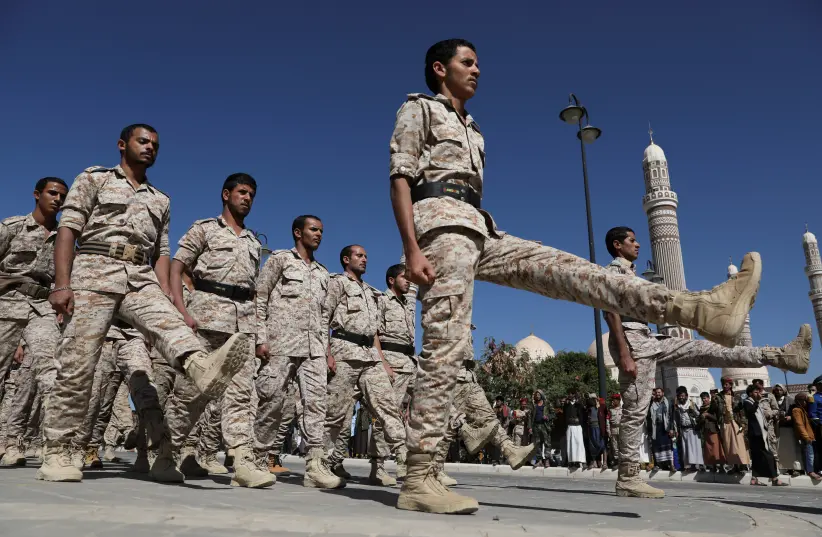
Syrian fighters attend a mock battle in anticipation of an attack by the regime on Idlib province and the surrounding countryside, during a graduation of new Hayat Tahrir al-Sham (HTS) members at a camp in the countryside of the northern Idlib province on August 14, 2018.

Abstract: Over the past decade, nowhere in the world has exerted as profound and transformative an impact on the global jihadi landscape as Syria. For al-Qaida, Syria had once been the source of its greatest hope, where dozens of its most experienced leading operatives were dispatched to enhance prospects of building a jihadi state. But in recent years, al-Qaida’s Syrian affiliate distanced itself and then broke away altogether, establishing a new locally oriented movement: Hayat Tahrir al-Sham (HTS). In pursuit of local dominance and ultimately survival, HTS has broken one jihadi taboo after another, including turning against al-Qa`ida and the Islamic State and dealing crippling defeats to both in Syria’s northwest. The implications and consequences of these developments are manifold. On the one hand, not only does HTS no longer represent the international terrorism threat that its predecessor once had, it has also almost entirely squashed the global threat posed by its more extreme rivals and played a role in maintaining the longest ceasefire in a decade of war in Syria. On the other hand, however, HTS’ de facto rule of northwestern Syria threatens to ‘mainstream’ a local jihadi model that looks set to experience a substantial boost by the Taliban’s surge to power in Afghanistan. Should conditions dramatically change, it could also come to represent a strategically significant terrorist safe haven once again—on Europe’s doorstep.

Over the past decade, nowhere in the world has exerted as profound and transformative an impact on the global jihadi landscape as Syria. It was on Syrian soil that the Islamic State in Iraq and the Levant (ISIL) first emerged in 2013 and where its behavior then sparked its expulsion from al-Qaida. That break-up and the Islamic State’s mid-2014 unilateral declaration of a caliphate caused shockwaves worldwide, catalyzing a split of the jihadi community into two rival and later globally hostile movements. As the world collectively mobilized against the Islamic State, al-Qaida was left reeling when faced by the Islamic State’s unprecedented challenge to its authority.

In response to the Islamic State’s transnational challenge, al-Qaida chose Syria as the focal point for its push back, dispatching many of its most senior and experienced operatives there to reinforce al-Qaida’s standing, through its affiliate Jabhat al-Nusra. While the arrival of the so-called “Khorasan Group” drew U.S. counterterrorism strikes, it also catalyzed internal tensions and an erratic process of introspection within Jabhat al-Nusra that eventually led to its departure from al-Qa`ida in 2017 and the advent of a third model of salafi-jihadi activity: Hayat Tahrir al-Sham (HTS) and its nationally oriented effort.

Iraq’s Kurdish regional leader Barzani defends Turkey’s Syria operation

Nechirvan Barzani, a powerful Kurdish leader in northern Iraq, argues that Turkey is targeting terrorists, not ‘the Kurds’.

The international outcry against the Turkish operation, which aimed to eradicate YPG presence from border areas in northern Syria, was based on one false premise: that the operation is targeting ‘the Kurds’, not terrorists. Now, Nechirvan Barzani, a powerful Kurdish leader, in Iraq has said that the Turkish military action has nothing to do with the Kurds, but is aimed at the PKK.

“Turkey’s problem, in the beginning, was not Kurds in Syria, it was the PKK. They were clear in saying one thing: ‘We cannot bear seeing the flag of the PKK on our borders with Syria,’” Barzani said, during a panel organised by the Erbil-based Middle East Research Center (MERI).

The YPG is the Syrian wing of the PKK, which has waged a decades-long terror campaign against the Turkish state, leading to tens of thousands of deaths across the country.

“Turkey had one demand, for Kurds to distinguish themselves from the PKK. Unfortunately, the PKK wanted to get legitimacy through Syrian Kurds,” Barzani said.

Barzani believes that the Turkish operation eventually happened “because of this wrong policy” conducted by the YPG in northern Syria.

The YPG has claimed large territories across northern Syria, manipulating the Syrian civil war as a pretext to form so-called ‘cantons’ in mostly Kurdish-populated areas.

The terror group took advantage of its longstanding relationship with the Assad regime to rule over Syrian Kurds, whom Damascus trusted to limit Kurdish opposition to the regime after reaching a deal with PKK leadership, located in northern Iraq’s Qandil mountains.

Syrian Militant and Former Al Qaeda Leader Seeks Wider Acceptance in First Interview With U.S. Journalist

Over most of two decades, Abu Mohammad al-Jolani’s life has been a roadmap of Islamist militancy in Iraq and Syria. He joined the fight against U.S. forces in Iraq and was jailed by the Americans. He became a commander within the group known as the Islamic State of Iraq. He founded an Al Qaeda affiliate in Syria and then broke with Al Qaeda and ISI, striking out with his own group to oppose Syrian President Bashar al-Assad.

Islamic State Increases Attacks on Iraqi and Kurdish Forces

The Islamic State terror group has increased its attacks on Iraqi and Kurdish security forces, killing nearly two dozen people in the last month, according to Iraqi officials.

Local government sources and public statements show that a wave of IS bombings and hit-and-run attacks, affecting largely the territories disputed between the Iraqi government and the Kurdistan Region, have killed at least 21 people and wounded dozens more.

US forces relocate Daesh members from camp in Syria to Iraq’s Mosul

The US military has secretly transferred Daesh families from the dangerous al-Hawl detention camp in Syria, which is run by allied Kurdish militants, to a facility in Iraq’s northern province of Nineveh, a report says.

A high-ranking Iraq security source, requesting anonymity, told Iraqi Arabic-language al-Maalomah news agency on Friday that American forces relocated scores of children and women to Jeddah camp some 65 kilometers (40 miles) south of Mosul.

The transfers took place under the supervision of authorities from the so-called Autonomous Administration of North and East Syria, also known as Rojava.

Ankara’s rejection of Kurdistan referendum unites Iraq and Turkey Kurds

Although the streets of Kurdish cities in Turkey were largely empty politicians took to social media to defend the Erbil government.

As pressure on the Kurdistan Region by the US, UK, France grew, with threats from Iran and Turkey and disapproval from the UN Security Council to postpone or cancel the Monday referendum on secession from Iraq, Kurdish factions across the region rallied to back the vote.

Kurds reject Baghdad ploy to divide Kurds with military threats

As the post-independence referendum fallout between Erbil and Baghdad reaches a dangerous juncture, Baghdad strives to divide the Kurds through military threats and conditions.

As the post-independence referendum fallout between Erbil and Baghdad reaches a dangerous juncture, Baghdad strives to divide the Kurds through military threats and conditions.

Syrian Kurdish enclave of Afrin: from forced conversions to demographic change

Monitoring groups and Kurdish media in Syria on Thursday said Turkish-backed Syrian opposition have transported thousands of families from Ghouta to the Kurdish enclave of Afrin over the last month.

Monitoring groups and Kurdish media in Syria on Thursday said Turkish-backed Syrian opposition have transported thousands of families from Ghouta to the Kurdish enclave of Afrin over the last month.