Constructive ambiguity may not be always constructive
Ever since Henry Kissinger coined the term, “constructive ambiguity” has become a favorite of diplomats across the world. But sometimes, ambiguity just doesn’t cut it.
Saleh Muslim, the co-chair of the Democratic Union Party (PYD), said on Wednesday that they are ready for dialogue with all parties including Turkey to solve the Syrian crisis.
Muslim told North Press, “We welcome all parties that want to solve the Syrian crisis and the Kurdish issue.”

Defense Minister Gantz tells reporters that since the Abraham Accords were signed, Israeli security officials held about 150 meetings with their regional counterparts and that ‘deals worth over $3 billion have been signed with countries in the region’

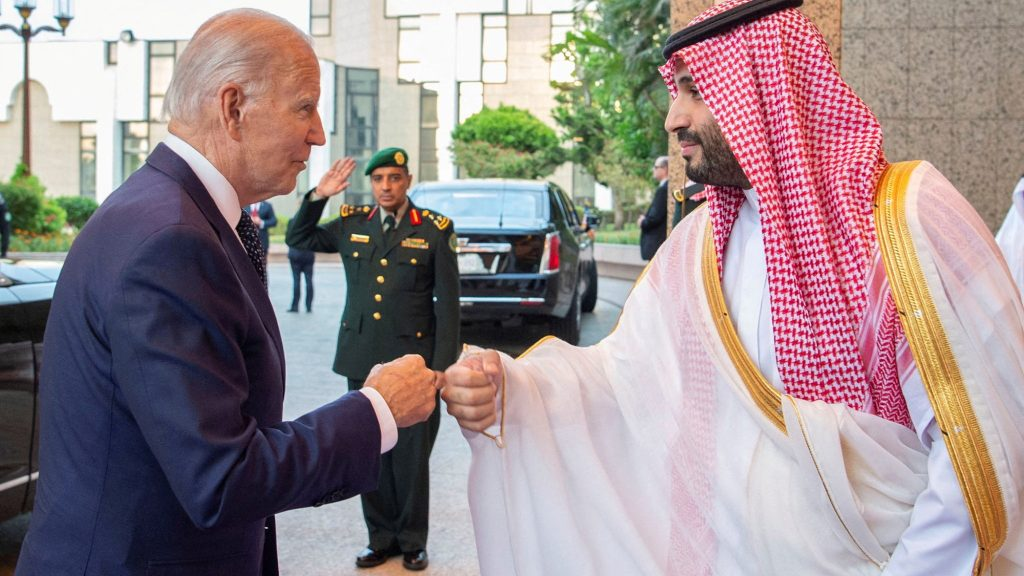
With all due respect to the commentary about Saudi oil production, there may be other reasons behind Biden’s Middle East trip next week, at a time when he has so many problems at home
Ostensibly, U.S. President Joe Biden’s trip to Saudi Arabia and Israel next week doesn’t make sense. The cost-benefit calculus is questionable as the tangible costs are clear and significantly outweigh any possible benefits. Unless it’s about something other than just visiting Israel and Saudi Arabia.

An unprecedented meeting could happen as soon as this month, according to a report citing one of Mohammed bin Salman’s advisors as U.S. President Biden is slated to arrive in Israel

Turkish defense firm and drone maker Baykar has donated three Bayraktar TB2 drones to the Ukrainian Armed Forces. A crowdfunding project was initially going to buy these crewless aerial vehicles (UAVs). However, in the spirit of camaraderie, they decided to give the three drones free.

What is at stake in the Security Council?
The UN Security Council is set to vote soon on the renewal of a mandate that allows UN agencies to deliver aid to rebel-held Idlib in north-western Syria via a border crossing with Türkiye without asking for approval from the government in Damascus. The UN calculates that nearly two and a half million people rely on this lifeline for food and other essential supplies. Yet the arrangement is contentious. Since 2019, Russia, the Syrian regime’s ally, has aimed to curtail the mandate, arguing that the UN should work with Damascus on aid deliveries out of respect for Syria’s sovereignty.

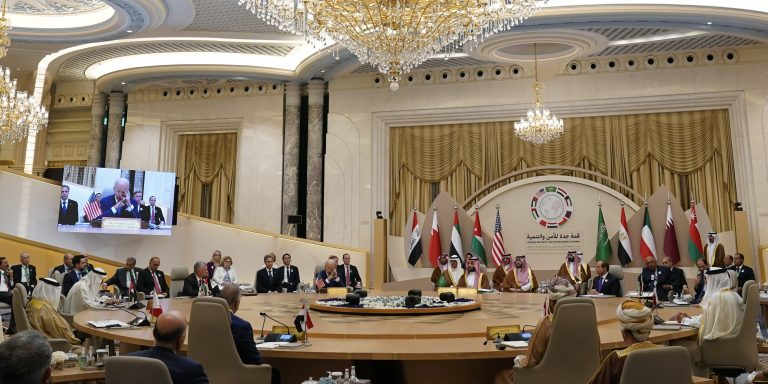
The pieces are aligning ahead of Biden’s trip to the Middle East next week — almost too neatly. But will it create or shatter stability?
Next week President Biden is headed to Saudi Arabia — which he once promised to treat like a “pariah” — reportedly intent on discussing broad security guarantees with the Kingdom, including an air defense umbrella. Unfortunately, the administration’s proposal will deepen U.S. entanglement in the Middle East and further strain Iran nuclear negotiations.

There is no legitimate case for Washington making new security commitments and assuming additional costs on behalf of Saudi Arabia and Israel.
There is increasing talk about the United States getting more deeply committed to anti-Iran security arrangements on the side of Arab states of the Persian Gulf, especially Saudi Arabia, and Israel.

The Syrian government forces are waging a revenge war against the Islamic State in the Syrian desert amid escalating attacks.
The Syrian desert known as the Badia region has been recently witnessing violent battles between the Syrian government forces and Islamic State (IS) militants, while Russian warplanes are raiding the group’s hideouts and military vehicles in the main clash area of Jebel Bishri, which extends over large areas south of Deir ez-Zor and Raqqa provinces in the east of the country.