An Israeli firm has supplied anti-drone systems to Ukraine through Poland, Israeli media revealed yesterday.
According to the Hebrew news website, Zman Yisrael, a source in the firm said that the equipment was being sold to Poland to circumvent Israel’s refusal to sell advanced arms to Ukraine.
Israeli political and security circles are concerned about the possible fall of Egyptian President Abdel Fattah Al-Sisi amid the ongoing internal crises that Cairo has been facing, an Israeli newspaper reported.
Two persons active in financing ISIS sleeper cells were arrested in the SDF operation, according to North Press.
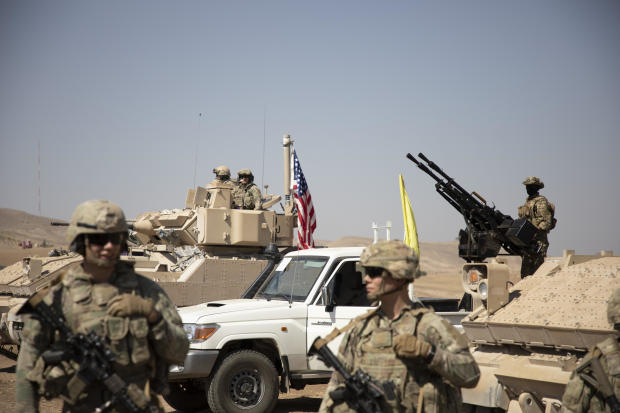
On Tuesday, the General Command of the Syrian Democratic Forces (SDF) revealed they carried out a security operation in cooperation with the U.S.-led Global Coalition to Defeat ISIS against collaborators with the Islamic State (ISIS) in the east of Hassakeh, northeastern Syria.
The Lebanese Hezbollah announced the arrest of cells in the Syrian army dealing with the Mossad, according to al-Hal Net.
The Lebanese Hezbollah announced the arrest of cells in the Syrian army dealing with the Mossad. This comes after Israel increased its attacks on Syria and since the beginning of this year, has targeted vital and sovereign areas in the country, such as the airports of Damascus, Aleppo and scientific research branches in Damascus, Tartous and Hama.
Head of the EU Delegation to Syria, Dan Stoenescu, said on Tuesday that all the Syrians have the right to return home, “but the conditions are not yet in place.”
This came during a meeting that took place between Stoenescu and UN High Commissioner for Refugees (UNHCR), Filipo Grandi in Damascus on Tuesday.
The SDC called for ending the Syrian tragedy and finding a sustainable solution via an intra-Syrian dialogue, according to North Press.
On Thursday, a number of Syrian parties and figures met with Mikhail Bogdanov, Special Representative of the President of Russia Vladimir Putin for the Middle East and North Africa and Deputy Minister of Foreign Affairs. They discussed reviving the political process in Syria.
The Taliban and Pakistani forces clashed on Wednesday in the eastern border province of Paktia as the Taliban accused Islamabad of erecting a military post on the border. Crisis Group expert Graeme Smith says tensions between the sides have been simmering for months and have occasionally escalated into armed clashes. Pakistan has grown frustrated with the sanctuary that Afghanistan’s new rulers have afforded the Pakistani Taliban (TTP), which is orchestrating a deadly cross-border campaign in Pakistan. Islamabad and the Taliban also disagree over the Durand Line, which the Taliban rejects as the official border and Pakistan continues to fence. The skirmishes take place as Taliban also battles the Islamic State’s local branch and armed resistance forces in the north.
It appears that calm has returned to Iraq after the reported intervention of Ayatollah Ali al-Sistani, the country’s chief and widely respected Shia cleric. In recent weeks, violence had occurred in and near parliament, which has been unable to implement last October’s election results. The clashes involved demonstrators and armed forces loyal to Moqtada al-Sadr, the leading candidate in the elections, and militias loyal to a loose array of rival Shia political parties calling themselves the Coordination Framework.
Iraq is facing one of its worst political crises in years. Normally formed via elite political consensus, more than 11 months after Iraq’s October 2021 parliamentary elections, the government has yet to be formed, the longest such impasse since the 2003 U.S.-led invasion reset the political order. Despite calls for dialogue, neither side seems willing to make mutually acceptable concessions. On Aug. 29 bloody street battles erupted in Baghdad and then in southern Iraq, leaving more than 30 dead and many more injured. Violence has stopped, for now, but the political crisis is far from over, even if superficial solutions may be found in the interim. Iraqis anxiously await the end of the Arba’een holiday on Sept. 17 to see what will happen next.
On Aug. 22, the northeastern Syrian city of al-Hasakah was inundated with leaflets condemning creeping Iranian influence in the area. The printed messages were plastered around several highly sensitive locations in the city center, including the local branch of the Ba’ath Party, the neighborhoods of al-Matar and al-Mahatah, as well as near the Great Mosque and market streets. Known colloquially as the “security square,” this area is under the control of the Syrian Arab Army (SAA), other regime security branches, including the Military Intelligence Directorate, as well as the National Defense Forces (NDF), a pro-government militia. Each of these groups has come under Iranian influence since the start of the Syrian war and today provides shelter for Iranian militias in the city and throughout the wider province.