The late March clashes between U.S. and Iran-backed militia forces in eastern Syria upended U.S. hopes that an Iran-Saudi rapprochement would usher in a period of regional stability and raised the potential for expanded U.S.-Iran hostilities.
Iran’s alignment with Russia, and the willingness of the Arab Gulf states to engage with Tehran, have emboldened Iran’s leadership to assert Iran’s regional influence.
The clashes in eastern Syria will not cause the United States to end the anti-Islamic State mission in Syria and Iraq but might set back U.S. and international hopes for a political solution to the long-running conflict in Yemen.
Israeli leaders will view the U.S.-Iran clashes in Syria as justification for escalating Israeli air operations against Iran-linked military infrastructure and militia positions in Syria, or possibly to attack inside Iran.
More than 50,000 jihadists are now living in Europe. — Gilles de Kerchove, EU Counterterrorism Coordinator.
Europol, the European police office, has identified at least 30,000 active jihadist websites, but EU legislation no longer requires internet service providers to collect and preserve metadata — including data on the location of jihadists — from their customers due to privacy concerns. De Kerchove said this was hindering the ability of police to identify and deter jihadists.
These posters reportedly contain threats of murder against men and women, including accusations of failing to pay “zakat” (Islamic tax) and other charges.
The UK-based Syrian Observatory for Human Rights (SOHR) war monitor on Tuesday reported that ISIS cells in the Arab-majority Deir ez-Zor province are spreading fear among civilians by hanging posters on walls, mosques, and electricity poles.
The Senate voted on Wednesday to advance a bill that would repeal the authorizations for combat operations in Iraq.
The measure to repeal the authorizations from 1991 and 2002 passed the Senate in a 66–30 vote with 18 Republicans and all present Democrats supporting the measure. It now heads to the GOP-controlled House where its future is uncertain. House Speaker Kevin McCarthy (R., Calif.) has said he is open to supporting a repeal after previously opposing it, according to the Associated Press.
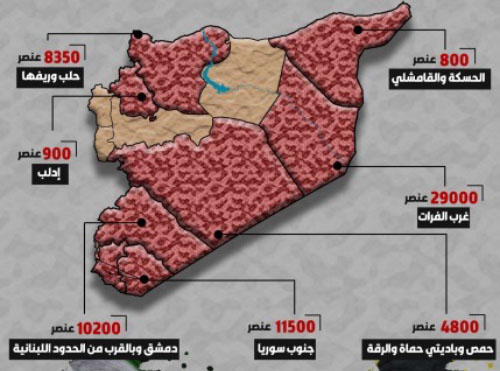
Several factors related to the civil war in Syria have engendered the cantonization of the country’s north. From east to west, five northern border regions are to various degrees self-governing, though four are backed by, and even dependent on, Türkiye. Ongoing indirect negotiations between Türkiye and Syria—which were previously at loggerheads—may result in an adjustment of the boundaries of these cantons, but will not alter, let alone reverse, the phenomenon of cantonization.
For decades, London has financed, trained, and sought to influence Islamic scholars, Imams, and their pious followers. The UK’s agenda is to mold Islamic influencers into promoting British narratives of the world.
After hours of traveling around the Iraqi border between the autonomous Kurdistan Region of Iraq (KRI) and Iran, you will come to a single conclusion: “This is a one-sided border.”
Twenty years after the unlawful and destabilizing US-led invasion of Iraq, Washington must face the ultimate consequence of that war: UNSC powers China and Russia laying the foundation for a genuine, UN Charter-based system of multipolarism.
On the night of 19-20 March, 2003, the US air force began bombing the Iraqi capital, Baghdad. The EU and NATO were deeply divided on whether to join the aggression: While newer NATO members from Central and Eastern Europe were in favor of the war, European heavyweights Paris and Berlin opposed it.
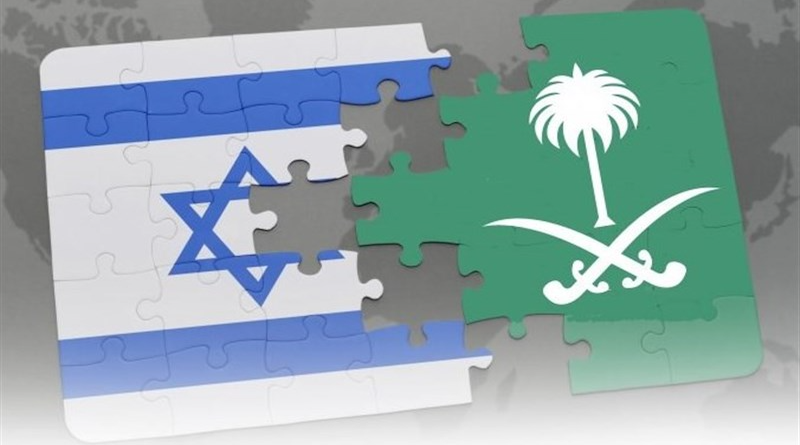
Riyadh refused Washington’s pressure to increase oil production, then faced blistering attacks on its oil facilities and infrastructure from Yemen. Under increasing pressure to end its siege on Yemen, what will the Saudis do?
A security official warned that Iran will give a prompt response to any pretext for an attack on the bases inside Syria established at the Damascus government’s request for the purpose of fighting terrorism.
Keivan Khosravi, spokesman for Iran’s Supreme National Security Council, issued the warning on Saturday after American officials claimed that Iran has been involved in attacks on illegal US bases inside the Syrian territory.