The al-Qaeda offshoot is focused on defending its territory from Russian-backed Syrian government forces, but it has also clashed with the Islamic State recently.
Several members of the Syrian militant group Hayat Tahrir al-Sham were killed in Russian airstrikes early Monday morning.
Turkey’s efforts to expand its influence in Africa often align with those of Russia, with both Ankara and Moscow holding back from condemning military coups and seeking to capitalize on post-colonial resentments.
A series of military takeovers in West Africa, the latest occurring in Niger last month, reveal the extent to which Turkish and Russian efforts converge in trying to leverage political shifts to the detriment of former colonial powers, chief among them France, and expand their own influence in the region.
US officials suggest that the Syrian jihadist group Hayat Tahrir al-Sham really was behind the death of Islamic State leader Abu al-Hussein al-Husseini al-Quraishi.
The Islamic State confirmed the death of its most recent leader, Abu al-Hussein al-Husseini al-Quraishi, on Aug. 3. The jihadist group said its self-styled “caliph” had been killed in clashes with the rival Hayat Tahrir al-Sham (HTS), the al-Qaeda offshoot that is dominant in Syria’s Idlib province, and not by Turkey back in April, as Ankara previously claimed. IS said HTS, which it called “Turkey’s tail,” had handed his body over to Turkish intelligence in a recorded message posted on the Telegram messaging app.
Turkey’s economy is in a bad way. In June the budget deficit, seven times higher than a year earlier, reached 219.6 billion lira ($8.37 billion). The forecast for July shows it widening still further.
On July 16 Turkey raised the tax on gasoline, adding to the recent two percent increase to VAT (value added tax) and five percent hike to corporation tax. Aimed at tackling the budget deficit, those tax hikes will have the deleterious side-effect of stoking inflation, which stood at 38 percent in June. Two days after the tax hike, the Turkish lira weakened to a record low of 26.6 against the dollar.
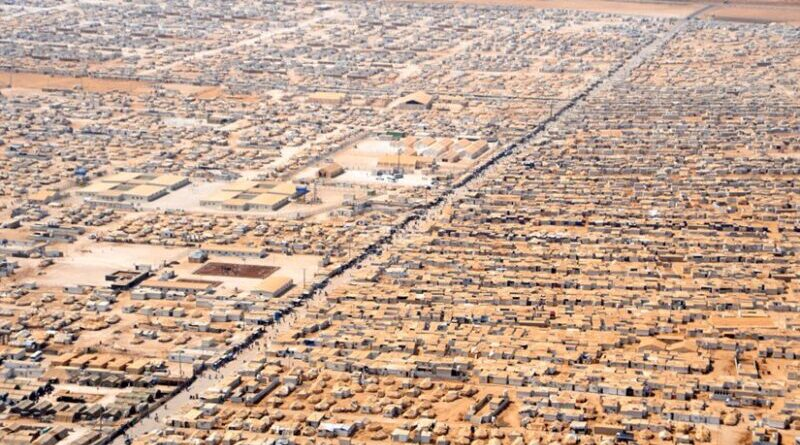
Ongoing fighting in the Ain al-Hilweh refugee camp may be part of a plan to weaken Fatah and undermine normalization with Israel.
In the past week, fighting erupted in the Palestinian refugee camp of Ain al-Hilweh near Sidon between Islamist factions and Fatah, after one of Fatah’s military commanders, Abou Ashraf al-Amroushi, was assassinated on July 30. While the fighting was hardly an anomaly, the fact that the head of the Palestinian General Intelligence Service, Majed Faraj, had visited Lebanon only days before fueled speculation that his visit might have triggered the fighting. Tensions between Hamas, which maintains good relations with Palestinian Islamists, and Fatah have surged in the West Bank and might have impacted the events in Ain al-Hilweh.
In mid-May, Iranian President Ebrahim Raisi issued a warning to the Taliban: honor Afghanistan’s water-supply agreement or face the consequences.
A well-known Taliban figure offered a mocking gift of a 20-liter water container in response and told him to stop making terrifying ultimatums. About a week later, a skirmish erupted on the border, leaving two Iranian guards and one Taliban member dead.
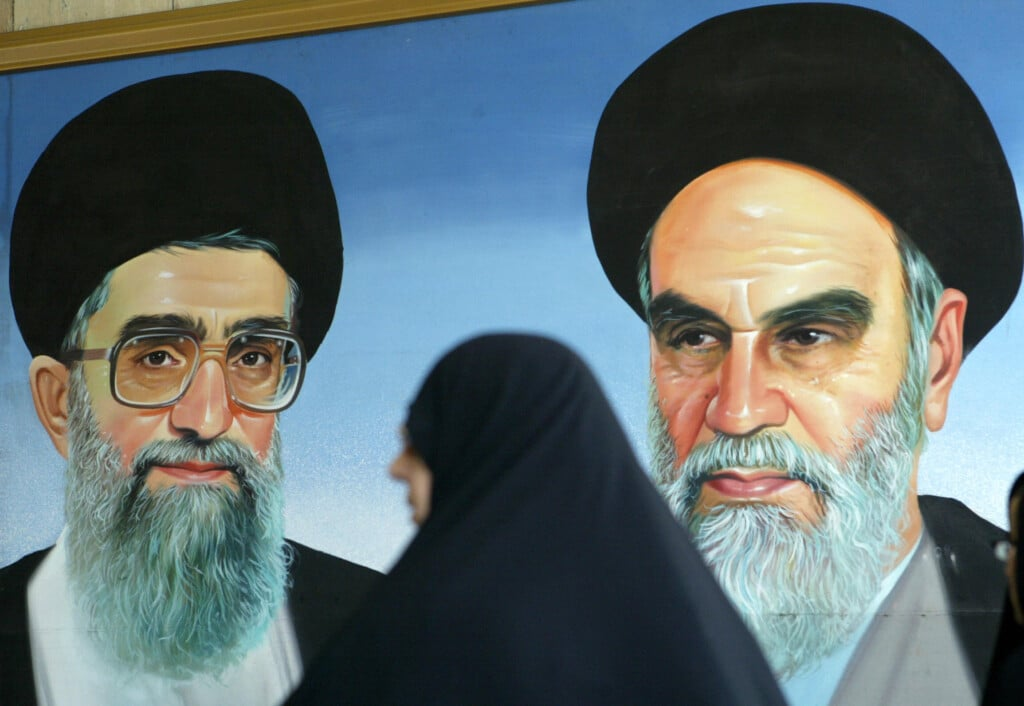
Over the past two years, as the United States and the European Union have invested in the revival of the 2015 Iran nuclear deal, the Iranian leadership has opted to solidify its non-Western foreign policy approach. In line with this approach, President Ebrahim Raisi embarked on a three-country trip to Africa in mid-July, marking the first time an Iranian president has undertaken such a visit in over 11 years. Earlier in the month, Iranian officials reported that the Islamic Republic’s exports to the continent had increased by 100% over the past year. It is now clear that engagement with Africa will be a major foreign policy focus under the Raisi administration. However, this is not the first time that Iran has taken such an approach to the continent. Former President Mahmoud Ahmadinejad implemented a similar policy from 2005 to 2013, although it did not yield significant results. This raises the question of whether, a decade on, Raisi’s Africa policy will prove any more successful.
The view across the Tigris River from the eighth floor of the Babylon Hotel reveals a telling mise-en-scène: As a giant neon billboard that adorns the gleaming 32-story Baghdad Mall flashes the Iraqi flag in between ads for Coca-Cola, the ghost of the late Iraqi-British architect Zaha Hadid looms large over her adjacent tower in progress. Commissioned in 2010 to be the headquarters for the Central Bank of Iraq and a symbol of a “new era,” it’s not yet finished, and the Australian engineer whose company helped build it is still languishing in Iraqi prison after a dispute about payment.
In an interview, Leonid Nersisyan examines Moscow’s stakes in the Levant and North Africa in light of the stalemated war in Ukraine.
Leonid Nersisyan is a defense analyst focusing on the foreign and military policy of Russia and the Commonwealth of Independent States region. He also follows the defense industry in general, as well as armed conflict and arms control. Nersisyan is a research fellow at the Applied Policy Research Institute of Armenia and a Ph.D. candidate at the University of Birmingham in the United Kingdom. Diwan interviewed Nersisyan in July to get his perspective on how the Ukraine war and its repercussions have affected Russia’s defense posture in the Middle East.
Is the community a purveyor of revolutionary change, a defender of the status quo, or a combination of both?
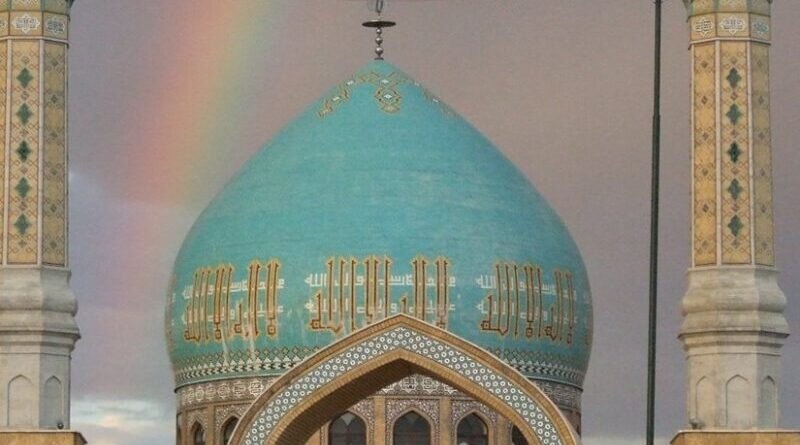
We are in the Muslim month of Muharram, a time of mourning for Shia Muslims, when they commemorate the martyrdom of Imam Hussein. Over the centuries, rituals during Muharram have been crucial in maintaining and energizing the Shia collectivity and helping to perpetuate its narratives, myths, and worldviews.