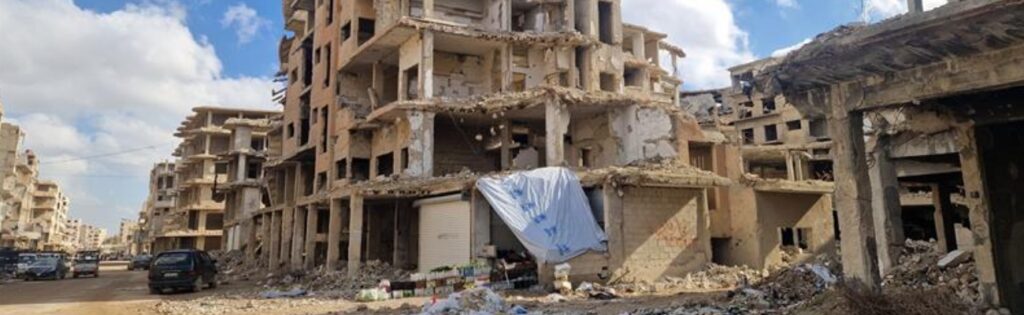
Syria has reached a significant milestone in its economic recovery with the export of its first crude oil shipment in 14 years. On Monday, 1 September 2025, 600,000 barrels of heavy crude were dispatched from the port of Tartous aboard the tanker Nissos Christiana, as announced by the Syrian Ministry of Energy.
The relationship between Syria and Iraq resists simple classification within conventional models of regional systems, yet it stands as one of the defining features of the Arab Levant’s modern history. This unique and enduring bond cannot be explained solely through the lens of ancient sectarian or theological divisions. To reduce it to historical rivalries—such as those between the Umayyads and Hashemites, or Sunni and Shia factions—is to perpetuate a flawed narrative of perpetual sectarian conflict.
Interim Syrian President Ahmad al-Sharaa pledged to dismantle his country’s massive illegal drug trade when he took power in December, but the dangerous amphetamine captagon is still flowing.
On September 1, Jordanian security forces announced that they “foiled two large-scale drug-smuggling attempts along the country’s eastern border [with Syria].” In August, Jordanian authorities intercepted at least 10 drug shipments, a significant increase from previous months.
On June 29, 2014, Abu Bakr al-Baghdadi, the leader of the Islamic State in al-Sham (ISIS), was recorded on video speaking at the al-Nuri Mosque in Mosul, Iraq. (“Al-Sham” is the traditional Arabic name for the Levant.) He declared himself to be the caliph or divinely inspired absolute ruler of an Islamic state.
ISIS had risen from the ashes of al-Qa’ida in Iraq, bringing together Syrian jhadists released by Asad’s regime, former members of Saddam Hussein’s army in Iraq, and Sunni tribal fighters from across rural Iraq. In Syria, ISIS joined other jihadist groups in fighting Asad. As its battlefield victories mounted, ISIS broke with al-Qai’da in declaring an Islamic state across eastern Syria and northern Iraq, with al-Raqqa in Syria as its capital.
More than a half century after the 1967 Arab-Israeli war and the passage of UN Security Council Resolution 242—which established the principle by which Israel would give up territory it gained in the war in exchange for peace and security—the Israelis and the Palestinians have made no meaningful, much less lasting, progress on their core differences.
It is time for this to change. What little opportunity still exists for realizing progress toward a durable agreement between the Israelis and the Palestinians—one that would serve both parties’ interests—is fast fading. Political and physical barriers to compromise will soon pass a tipping point.
According to the Department of Justice, in the early 1990s, the Muslim Brotherhood, planned to establish a network of organizations in the US to spread a militant Islamist message and raise money for Hamas. The Texas-based Holy Land Foundation for Relief and Development (HLF) became the chief fundraising arm for the Palestine Committee in the US, created by the MB to support Hamas. In 2008, HLF leaders were convicted of crimes, including providing material support for Hamas.
The demonstrations organized by the Druze community in Suwayda, demanding the right to self-determination and declaring independence from Syria, were neither a fleeting episode nor a simple reaction to the brutal crackdown launched by the transitional authority in Damascus last July. That assault on the Mount of Druze claimed thousands of deaths and grave human rights violations, leaving enduring scars on the community.
A recent article by Dr. Ahmed Muwaffaq Zaidan on Al Jazeera, urging the dissolution of the Muslim Brotherhood in Syria, has stirred debate. Some welcomed the idea as a way to move beyond a long-burdensome legacy; others saw it as a worrying signal of exclusion at a moment that calls for unity.
Launched at the 2023 Group of Twenty (G20) summit in New Delhi, the India-Middle East-Europe Economic Corridor (IMEC) features three pillars that integrate existing and future infrastructure: a transportation pillar—the corridor’s backbone—integrating rail and maritime networks, an energy pillar with interconnected energy and electricity infrastructure across continents, and a digital pillar providing new fiber-optic cables and cross-border digital infrastructure.