
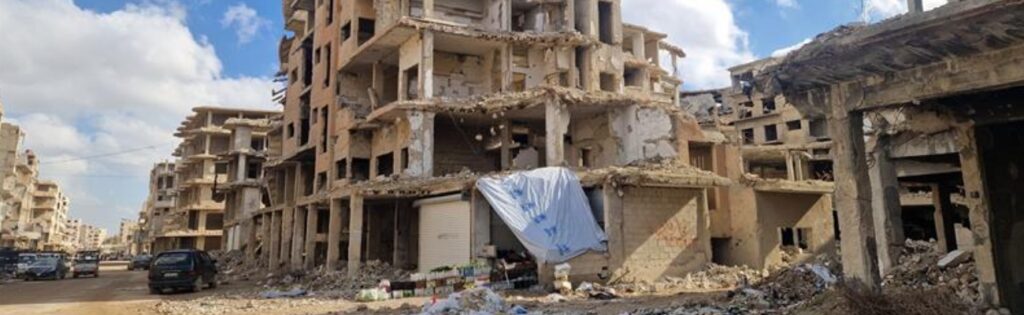
The fall of the Assad regime marked the start of a new and risky journey to rebuild and repair what 14 years of war destroyed, including securing housing for millions living in camps, and for displaced Syrians and refugees whose homes were destroyed.
The war forced millions of Syrians into displacement and exile, turning the search for shelter into a dream amid harsh living conditions, low incomes, and property prices that have reached astronomical levels beyond people’s means.
In this report, Enab Baladi examines the reality of Syria’s housing crisis after years of war, the vast scale of destruction to housing and infrastructure, and the sharp gap between property, construction, and renovation costs and people’s limited means, making home ownership, and even renting, a major challenge.
It also examines, with experts, the economic challenges hindering reconstruction, including the enormous cost of projects, the absence of urban planning and investment, the stagnation of the real estate market and rising prices, weak government policies, and the absence of comprehensive and sustainable solutions to guarantee a safe and dignified return for residents.
The report also discusses the layered housing crisis, in which economic, service, and regulatory dimensions overlap.
Widespread Destruction and a Heavy Reconstruction Bill
A UN report issued on January 26 revealed the scale of destruction in Syria’s housing sector. The shelter and infrastructure crisis remains one of the biggest obstacles to stability, recovery, and the safe return of displaced people, noting that around one-third of the country’s residential buildings are damaged or destroyed.
Vital infrastructure, including water, electricity, and sewage networks, is suffering from widespread dysfunction, especially in areas that experienced prolonged conflict or severe destruction.
According to the UN assessment, 89% of the communities surveyed reported damage to their housing stock, while about half said more than 50% of their homes had been damaged, with the highest destruction rates recorded in the southern governorates and the northwest.
An analysis of satellite images conducted by the United Nations Institute for Training and Research, UNITAR, showed major building destruction in at least 16 Syrian cities as a result of the devastating war that tore through Syrian cities and towns.
According to the analysis issued in August 2025, the number of buildings completely destroyed or damaged to varying degrees reached 355,722 in Aleppo, 1,415 in Idlib, 12,781 in Raqqa, 6,405 in Deir Ezzor, 10,529 in Hama, 13,778 in Homs, 34,136 in Eastern Ghouta, 5,489 in Yarmouk Camp and al-Hajar al-Aswad, 3,364 in Zabadani (Rural Damascus), and 1,503 in Daraa.
UN Report, More Than 1.5 Million Without Homes
The UN report issued last January found that 7.4 million people were still displaced as of December 2025, including more than 1.5 million living in tents, unfinished buildings, or overcrowded collective shelters not designed for long-term residence.
The February 2023 earthquake that struck northern and western Syria worsened the housing crisis after destroying more than 47,000 additional homes and displacing tens of thousands of families.
The report also recorded a notable rise in refugee and internally displaced returns, noting that 1.26 million people had returned to Syria since December 2024. Yet many returned to damaged, looted, or uninhabitable homes, especially in Damascus, Aleppo, Idlib, and Homs governorates.
Most housing damage was classified as repairable, with the report estimating that around 79% of damaged homes could be rehabilitated, while 21% require full reconstruction. Even so, restoration efforts face major obstacles, including funding shortages, rising construction material costs, damage to surrounding infrastructure, and a limited skilled labor force.
Damaged homes also remain widely inhabited, including units classified by the United Nations as structurally unsafe, exposing residents to growing health and protection risks, including unexploded remnants of war, lack of privacy, and rising crime rates.
The report concluded that there is a clear gap between the pace of return and the actual condition of housing and infrastructure, stressing that return in many cases is driven by the absence of alternatives rather than the availability of safe conditions. That underlines the urgent need to expand housing rehabilitation programs and support early recovery to ensure a safer and more sustainable return.
Reconstruction Bill, Between $200 Billion and $1 Trillion
The World Bank estimated Syria’s reconstruction cost, under a middle-range scenario, at around $216 billion in a report issued on October 21, 2025.
The assessment of physical damage and reconstruction across Syria covers infrastructure and buildings from 2011 to 2024. The war damaged nearly one-third of Syria’s total pre-war fixed capital stock, including buildings, factories, machinery, equipment, means of transport such as trucks, and technologies used in production.
The bank estimated direct physical damage to infrastructure and residential and non-residential buildings at around $108 billion. Infrastructure was among the hardest-hit categories, accounting for 48% of total damage, or $52 billion, followed by residential buildings at $33 billion, then non-residential buildings at $23 billion.
UN estimates put the cost of reconstruction between $250 billion and $400 billion.
Syrian Economy Minister Mohammad al-Shaar told Reuters in October 2025 that the cost of reconstruction in Syria could exceed $1 trillion if infrastructure were rebuilt using modern methods. He added that the process would take a long time, while rebuilding homes alone would take between six and seven years.
Real Estate Between Stagnation, Need, and the Absence of Projects
Syria’s real estate sector is experiencing an unprecedented state of inflationary stagnation, with prices hundreds of times higher than the incomes of most Syrians, and with almost no meaningful government intervention to curb prices or narrow the vast gap between property values and wages.
Syrian real estate expert and appraiser Fawaz al-Shami said limited supply is one of the main reasons behind rising property prices, but added, “We cannot generalize the issue of low supply, because in some areas supply is much greater than demand.”
Rent Devours Salaries, Ownership Out of Reach
Retired employee Wael al-Ali said, “I struggled a great deal throughout my long life to obtain a home, but to no avail. My main concern is securing the rent for the house I live in.”
Wael lives in Sahnaya (Rural Damascus) and pays $300 a month, according to his account.
He added, “My salary does not exceed 900,000 Syrian pounds, while the cheapest apartment in Rural Damascus may cost between 200 million and 500 million Syrian pounds, or more, depending on the area, and the dollar is equivalent to 12,350 Syrian pounds.”
Wael said a current employee’s salary may now reach 2 million Syrian pounds after the latest raise, meaning that person would need hundreds or even thousands of salaries to be able to buy a home, something unrealistic without outside support or additional sources of income.
Rami al-Daher, who was displaced from al-Hajar al-Aswad in 2012, told Enab Baladi that he is living in rented housing in Nahr Aisha, Damascus, and that the cost of building a new home in his area is no less than 200 million Syrian pounds, far beyond his means. He expressed surprise at the absence of government plans to solve the housing problem now affecting millions of displaced and uprooted Syrians.
“The state must take measures to help residents who are powerless in the face of the insane rise in house prices,” Rami said. He added that he works in a freelance trade, painting walls, but earns no more than 3 million Syrian pounds a month, with the dollar equal to 12,350 Syrian pounds, a sum insufficient to cover the needs of his family of four, while the dream of owning a home has become out of reach.
Abu Jamil al-Omari, a former employee, told Enab Baladi, “Since 1995, I have been trying to buy a home in Syria, but it was very difficult because of the large gap between salaries and property prices at that time.”
He added, “An employee’s salary ranged roughly between 2,000 and 5,000 Syrian pounds, while apartment prices started at hundreds of thousands of pounds. Although prices were much lower than they are today, they were still high relative to income, and saving required many long years.”
The Supply and Demand Gap Paralyzes the Real Estate Market
Many owners of real estate offices in Damascus and its countryside, including al-Kiswah, Ashrafiyat Sahnaya, Mezzeh 86, Sidi Miqdad, and al-Tadamon, declined to speak to Enab Baladi under their real names about property prices. They cited the sensitivity of the market, unstable prices, fear of accountability or pressure, lack of clarity in pricing, and weak trust in media coverage.
“T.A.,” the owner of a real estate office in Ashrafiyat Sahnaya (Rural Damascus), told Enab Baladi that property prices vary according to location, size, construction quality, and available services, all of which contribute to either raising or lowering the price. He added that, compared with employee incomes, property prices exceed earnings hundreds of times over.
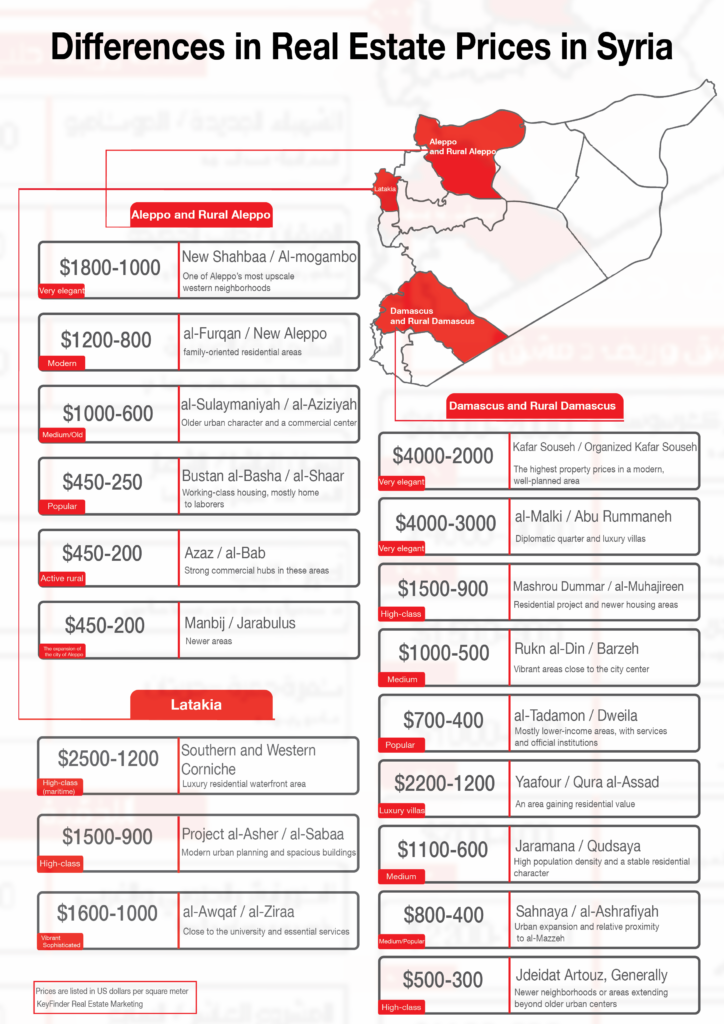
Proximity to main roads and the availability of good infrastructure, electricity, water, sewage, and telephone service, are among the main factors driving prices upward. The office owner said the price per square meter for unfinished residential property in either Sahnaya or Ashrafiyat Sahnaya ranges between $200 at the low end and $800 at the high end, and that most sales are conducted in dollars.
The real estate market is currently witnessing a near-total freeze, despite relatively active residential construction, which he attributed to weak purchasing power and rising building costs, creating a clear gap between supply and demand.
In his view, this stagnation is not limited to one area, but covers most of Damascus and its countryside. The market recorded a major decline in buying and selling activity during 2025 and 2026 despite continued sharp price rises, while soaring building material prices and general inflation across the country helped drive up both property prices and rents.
By contrast, the rental market is more active than the sales market, according to the office owner, as some residents have returned to their areas.
Frozen Markets and the Absence of Government Projects
Real estate expert and appraiser Dr. Mohammad Warda, a member of the Real Estate Finance Supervisory Authority, believes Syria’s real estate scene is governed by a complex equation that begins with rising prices of zoned land amid a clear shortage of new urban plans, creating artificial scarcity that steadily drives up value.
He said construction costs are no longer what they used to be, as the prices of materials and labor have surged because of limited activity that is nonetheless sufficient to raise demand, which has directly affected final property prices.
At the same time, the market suffers from a severe shortage of ready housing, especially with large swaths of damaged areas still out of service, creating a large gap between supply and demand.
Syria’s real estate landscape is governed by a complex equation that begins with rising prices for zoned land amid a clear shortage of new urban plans, creating artificial scarcity that steadily drives up value.

Dr. Mohammad Warda

Real Estate Appraiser and Expert
Real Estate as a Refuge for the Anxious
Dr. Mohammad Warda said inflation plays a central role in lifting prices, but that in many cases it is a nominal increase reflecting the erosion of the currency’s value more than real market growth. This reality has pushed a wide segment of Syrians to turn to real estate as a safe haven, especially amid fluctuating gold prices and the absence of reliable domestic investment alternatives.
At the same time, according to Warda, demand is rising because of the return of some Syrians and the desire of others to secure future housing, putting heavy pressure on a market with limited supply. The collapse of competing markets, such as the car market, has also helped turn real estate into an almost sole destination for investment.
Theoretically, Warda explained, a fair price is built on clear criteria that include land cost, construction cost, taxes, and market comparison.
But the reality is entirely different, with arbitrary pricing prevailing in the absence of scientific and administrative controls governing the market. He stressed that Syria’s property market is not one single block, but a collection of unequal markets that vary from one city to another and from one neighborhood to another according to local conditions and services.
For that reason, talk of a “fair price” remains relative and requires a precise reading of the local context in each area.
Weak Incomes and Low Purchasing Power
Dr. Mohammad Warda believes the problem does not lie in prices themselves, but in weak income levels and low purchasing power, which make real estate seem unattainable for most Syrians.
He said prices, compared with neighboring countries, are not necessarily high, but they become high when measured against local income.
Even so, real estate remains attractive to investors who hold hard currency, while it places a heavy burden on those whose income is in Syrian pounds. Investment in this sector, however, is not without risk, given difficulties in liquidation and legal and administrative volatility, making it an option with uncertain results.
So far, there are no signs of falling prices in any area, as demand continues to expand without enough supply to match it, according to the expert, who noted that mortgage finance remains entirely absent, limiting its effect on prices for now.
Warda described the current market reality as “inflationary stagnation,” where prices swell without real trading activity, with a clear tendency to hold property rather than sell it. This leaves the market suspended between need and anxiety in an exceptional scene that is difficult to classify.
The Absence of Urban Development Projects
Fawaz al-Shami, a real estate expert, appraiser, and member of the Real Estate Finance Supervisory Authority, explained to Enab Baladi the main reasons behind rising property prices in Syria in recent years:
The weakness of the transportation sector, which makes demand greater inside cities and therefore raises urban property prices.
The governorate’s failure to organize new residential zones to meet housing demand, with the last completed residential zoning plan being Kafarsouseh in the early 1980s.
The absence of urban development projects that could provide housing at competitive prices, given the large scale of such projects and their location on city outskirts, where prices are lower and can therefore help reduce costs.
The lack of other safe and transparent investment channels, such as buying shares in joint-stock companies.
He noted that property prices are naturally affected by building and material costs, which have declined noticeably in recent times. Regarding the current gap between property prices and employee salaries, al-Shami said, “Employee salaries are the problem. They are not proportionate to the minimum daily cost of living, and therefore one of the government’s priorities should be to improve salaries gradually according to the means available.”
“There is no inflation in the Syrian real estate market, there is stagnation,” al-Shami said, explaining that areas that were theaters of war, such as Harasta and Daraya (Rural Damascus), saw price rises. He added that small apartments ranging from 90 to 130 square meters saw higher demand and a modest increase in prices.
Vague Investments and Complete Government Silence
Despite the large jumps in residential and commercial property prices, the government’s position has remained unchanged. Finance directorates have continued to follow the same method in assessing and adjusting the prevailing value of property.
Finance directorates and finance offices form subcommittees to determine the prevailing value of all properties in cities, towns, and villages under Law No. 15 of 2021, as well as principal committees in the governorates and a central committee at the Ministry of Finance for oversight and approval.
The task of these committees is limited to proposing price brackets and an average prevailing value per square meter for each bracket based on the financial classification of the property, whether residential, commercial, or agricultural, and uploading them to electronic maps. Assessment criteria rely on geographic location, property type, and topographic description, after which the maps are periodically reopened to adjust prices in line with market value.
Al-Shami said the prevailing value of any property is an estimated value set by the Ministry of Finance for tax purposes and updated every few months, while the real price depends on actual sale prices on the ground.
There is a gap between the prevailing value and the market price, but in general the prevailing price is 10% to 30% lower than the real price of any property. “Unfortunately, assessment depends heavily on experience because there are no mechanisms to determine which properties were sold and at what actual prices,” al-Shami said.
Real Estate Investments Worth Billions of Dollars
Most real estate investments signed since the fall of the regime have been marked by opacity and privatization, without any indication of whether they will help reduce property prices or provide alternative housing for those who have none.
According to Karam Shaar Advisory, 20 memorandums of understanding were recorded in the post-war phase, most of them in the real estate, construction, and building sectors. They were announced between Syrian government institutions and foreign companies, and the value of only 15 of them was disclosed, totaling $19 billion, while no details were provided regarding the other five memorandums.
In July 2025, 47 memorandums of understanding and preliminary agreements were signed between several Syrian government institutions and Saudi companies during the Syrian-Saudi Investment Forum in Damascus, with a total value of $6.4 billion.
The agreements covered infrastructure and real estate development, which accounted for the largest share of total investments, in addition to telecommunications, information technology, industry, tourism, and health.
Government Efforts and the Future of Cooperative Housing
After the fall of the former regime, the new Syrian government formed a committee to examine the state of cooperative housing associations across Syrian governorates, with the aim of verifying subscribers’ complaints about corruption files from previous periods.
Public Works and Housing Minister Mustafa Abdul Razzaq announced on March 18, 2025, that the committee had completed its work and that several measures had been taken, including coordination with the Central Bank of Syria to release the accounts of housing associations in all banks, except for some associations that are still under detailed review in order to protect subscribers’ rights.
Regarding the impact of abolishing the General Cooperative Housing Union on the establishment of new housing associations, Osama al-Shaabani, director of the Housing Cooperation Directorate at the Ministry of Public Works and Housing, told Enab Baladi that the move had no effect on the creation of new associations.
Al-Shaabani said the decision to halt the formal registration of cooperative associations had been issued before the union was abolished and merged into the Ministry of Public Works and Housing as the Housing Cooperation Administration, stressing that existing and active associations are still capable of carrying out new housing projects.
Youth Housing, Costs and Subscriptions
As part of the government’s efforts to provide suitable housing solutions for young people, the General Housing Establishment continues to work on the youth housing project. Despite the challenges imposed by economic conditions, the project seeks to provide an adequate housing environment, according to General Housing Establishment director Tamam al-Dabl.
Al-Dabl said the youth housing project is still moving forward despite the challenges it has faced in recent years, especially rising construction costs and the broader economic situation, without disclosing their value. He explained that the General Housing Establishment is currently working to complete existing projects according to specific priorities, while also taking steps to address subscribers’ situations and speed up implementation.
Estimated housing costs are also being reassessed periodically, which may be reflected in adjusted installments to align with economic reality while taking repayment capacity into account, according to al-Dabl, who stressed that the institution is committed to completing this vital project and handing homes over to those entitled to them under a gradual, studied plan.
The Local Administration Ministry Was “Too Busy” to Respond

Enab Baladi contacted the Syrian Ministry of Local Administration and Environment to ask about housing projects that had recently been agreed, whether there was government support for the ministry’s efforts in this field and the size of that support, and the main reasons behind the slow pace of reconstruction in damaged areas and the limited number of new housing projects.

The ministry’s media office initially required Enab Baladi to first obtain answers from the Ministry of Public Works and Housing, even though reconstruction falls under Local Administration’s jurisdiction, then apologized for not answering the questions, citing the office’s preoccupation with the consultative workshop launched by the ministry to prepare the national program for priority projects under climate change conditions.

The media office at the General Directorate of Cadastral Affairs said the directorate has no role in setting prices, as that falls under the Ministry of Finance, which determines the “prevailing value” of properties.

It added that the directorate’s role is limited to setting fees for real estate services, noting that those fees do not affect property prices.
Demand and Regulatory Chaos in the Property Market
Syria’s real estate market is in a state of complexity because of the overlap of several economic and regulatory factors, in addition to the absence of clear laws governing investment and reconstruction, which has affected price levels and demand amid challenges linked to urban planning and property organization, according to architect Mazhar Sharbaji.
According to Sharbaji, Syria’s property crisis is concentrated in areas such as Damascus and Aleppo because most people want to work and settle there. The market also suffers from accumulated problems, most notably inheritance disputes, illegal possession, failure to correct property descriptions, and technical problems that obstruct proper property organization.
He added that the difficult economic situation is another influential factor, along with increased demand resulting from the return of expatriates and the expectations that accompany possible price rises or declines.
There is also widespread fear among residents over an abnormal rise in property prices, especially in damaged areas such as al-Muadamiyah, Daraya (Rural Damascus), and Jobar, where, according to Sharbaji, investor attention is focused on the slogans of reconstruction and tower building, without clear laws regulating investment mechanisms.
Sharbaji also noted a large real estate vacuum around Damascus and in the rest of the governorates, indicating major shortcomings in urban planning across Syria. He said part of current prices is illusory and may lead to future inflation because of the absence of a clear vision for urban planning and regulatory legislation, which the People’s Assembly, which has not yet begun its work, has still not issued.
If foreign companies, or local companies working in cooperation with international firms, were present alongside financial support, a clear plan, sufficient liquidity, and a strong state economy, tangible progress could be made in securing housing for a certain segment of citizens.
If foreign companies, or local companies working in partnership with international firms, were present, alongside financial support, a clear plan, sufficient liquidity, and a strong state economy, tangible progress could be made in providing housing for a segment of citizens.

Mazhar Sharbaji

Architect
Housing Projects, the Most Urgent Need
Housing projects are the most urgent need given the scale of destruction, yet implementation on the ground remains limited, while current activity is focused on agreements for tourism, economic, and industrial projects, according to architect Mazhar Sharbaji.
Questions also arise over how suitable the infrastructure is for large-scale urban development projects and over the need to involve local residents in decision-making, especially in rural and agricultural areas that do not fit the residential tower model, according to Sharbaji.
He added that one of the main obstacles to reconstruction is the state’s financial condition. In principle, it should have a strong treasury, along with international aid and support, but reality indicates that financial resources are not sufficient to implement projects effectively.
As for the expected time needed to implement new housing projects, he said local projects on their own face major difficulties in execution. But if foreign companies, or local firms working with international ones, were present alongside financial support, a clear plan, sufficient liquidity, and a strong state economy, tangible progress could be made in securing housing for a certain segment of citizens.
He also stressed the importance of available expertise and qualified cadres, and the existence of a governance environment that allows the private sector, mixed sector, civil society, and governments to work together.