
Israel intensified its attacks on Gaza and Lebanon, deadly state repression across Iran halts protests, and violence escalated between state forces and the SDF in northern Syria.
Gaza: Violence escalates amid the US launch of phase 2 of the Gaza peace plan
Violence intensified in Gaza in January, with the highest number of Israeli attacks since the current ceasefire began on 10 October. At least 160 Palestinians were killed during the month — double the previous month’s toll — as Israeli forces continued to use lethal force against civilians approaching the Yellow Line or collecting firewood, while also targeting militants attempting to cross into Israeli-controlled areas or plant explosive devices. Israel also carried out repeated strikes across Hamas-controlled areas in response to incidents in Rafah, including two attempted attacks on Israeli troops by Hamas gunmen emerging from tunnels, a failed missile launch, and militant activity near the Yellow Line. On 31 January, Israel carried out its deadliest attack wave of the month, killing at least 32 Palestinians, including civilians, militants, and police officers.1
Against this backdrop, the US launched phase 2 of its Gaza peace plan on 14 January, which included the establishment of the National Committee for the Administration of Gaza, following the recovery of the last Israeli abductee’s remains.2 However, the transition remains constrained by unresolved security disputes, particularly over Hamas’ disarmament. Hamas has not publicly agreed to disarm, instead calling for integration of its police into the new committee,3 while Israel continues to demand full disarmament, citing concerns over Hamas’ growing power and continued control over Gaza4 as key obstacles.
Iran: Mass repression halts protests as coercive pressure from the US intensifies
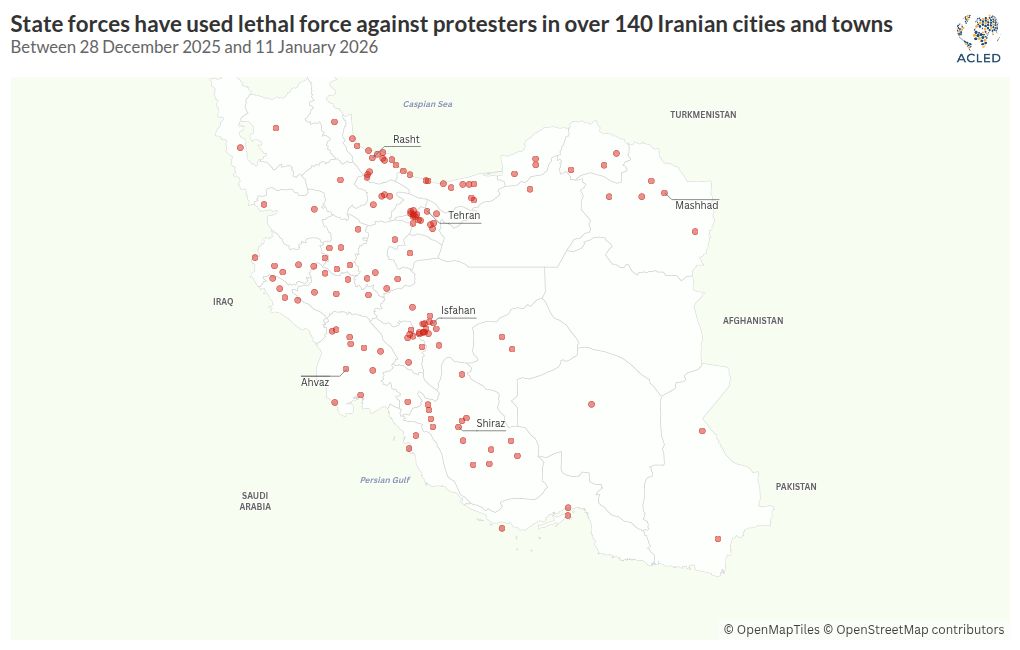
Protests in Iran largely subsided following the regime’s violent repression on 8 to 9 January — the most lethal episode of state violence against protesters in Iran’s contemporary history — with fatalities reaching well into the thousands. Continued mass arrests, intimidation, and censorship of information flows, combined with the sheer scale of reported fatalities, have made verification slow and highly complex. ACLED has recorded the use of lethal force against protesters in over 140 cities and towns nationwide, while human rights organizations5 and reports citing medical sources inside Iran6 indicate death tolls far exceeding the figure of just over 3,100 that Iranian authorities have officially acknowledged.7 While repression has for now cleared the streets, political anger and social polarization have been sharply exacerbated by the killings, increasing the risk that any renewed unrest could take more radicalized and violent forms.
Against this backdrop, prospective US-Iran negotiations are taking shape under heavy US coercive pressure. After publicly signaling support for protesters but ultimately refraining from intervention, Donald Trump has ordered a significant military buildup in the region, though it remains unclear whether this is a prelude to direct military action or primarily a tool to compel concessions from Tehran. Countries in the region, including Turkey and Qatar, have stepped up mediation efforts amid concerns that further escalation could trigger a broader conflict. Talks are reportedly scheduled for Friday, but the core uncertainty is whether the limited concessions Iran appears prepared to offer meet Washington’s minimum demands. With little indication that Tehran is willing to move beyond the nuclear file,8 and Israel continuing to press Washington to include Iran’s ballistic missile program and regional nonstate allies in any agreement,9 it remains uncertain whether the talks will move beyond a temporary easing of military pressure.
Lebanon: Increased military pressure amid regional tensions
Israel’s dissatisfaction with the pace of Hezbollah’s disarmament, alongside heightened US-Iran tensions, translated into a marked escalation of Israeli military activity in Lebanon in January. Airstrikes and artillery fire reached their highest level since the November 2024 ceasefire, rising by over 20% from December. Operations remained concentrated south of the Litani, accounting for over 90% of strikes, though continued strikes north of the river indicate Israel is intent on sustaining pressure on Hezbollah’s operational depth.
As Israel intensifies its campaign against Hezbollah, regional tensions between the US and Iran prompted rhetorical responses from the group. In comments on 26 January, Hezbollah Secretary-General Sheikh Naim Qassem maintained that the group would “not be neutral” if Iran was attacked and spoke of such a war setting the “entire region ablaze.”10 Despite the forceful posturing, Hezbollah faces mounting constraints, as Iran’s overlapping crises limit its ability to provide support while Israel and the US continue to press for disarmament.
Syria: Fragile agreement in northeast Syria amid escalating civilian casualties
Fighting between Syrian government forces and the Syrian Democratic Forces (SDF) escalated sharply in January following the collapse of months of US-mediated talks over the SDF’s integration into the Syrian state. Hostilities broke out between 6 and 10 January in Kurdish-held neighborhoods of Aleppo before expanding eastward across the Euphrates into Raqqa and Deir al-Zor by mid-January, and later Hasakeh, as government advances and large-scale defections by Arab SDF elements rapidly eroded SDF territorial control (for more, see this expert comment on tensions between the Syrian government and the SDF). The fighting was accompanied by targeted violence against civilian populations, resulting in at least 193 reported fatalities during the month. ACLED records dozens of retaliatory acts of violence attributed to SDF forces against the Arab citizens in SDF-controlled areas. A smaller number of civilians were also killed in Syrian government operations.
On 30 January, the Syrian government reached a “comprehensive” agreement11 with the SDF, following the collapse of an earlier ceasefire reached on 18 January. The agreement stipulates that government forces will enter the centers of Hasakeh and Qamishli — thereby effectively ending the Autonomous Administration’s control in favor of restored state sovereignty — and outlines a phased process for integrating SDF forces and institutions into state structures. Initial implementation began in early February, but the process remains fragile. Ambiguity over interpretation terms, as well as continued attacks and arrests by the SDF on civilians celebrating the entry of the Syrian army, continue to generate tension, leaving civilians exposed should the agreement falter and hostilities resume.
Yemen: Relative calm in spite of major political and military reshuffling in southern Yemen
In January, Saudi-backed forces affiliated with the Presidential Leadership Council (PLC) reversed all Southern Transitional Council (STC) territorial gains from December, culminating in the conquest of Aden on 7 January and the dissolution of the STC (for more details, see this ACLED Q&A).
STC-affiliated forces showed no resistance to the advancement of PLC forces, and the PLC began sweeping reforms to incorporate STC forces under it. On 10 January, PLC chairman Rashad al-Alimi announced the formation of a new body, the Supreme Military Committee, to unite pro-PLC forces for the “next phase” of the conflict against the Houthis.12 The new body will bring all anti-Houthi forces in territories under the control of the Internationally Recognized Government into a single command overseen by the Saudi-led Coalition to Support Legitimacy. As part of this process, the STC’s main security and counter-terrorism forces, the Security Belt Forces and the Support and Reinforcement Brigades, were brought under the PLC-controlled National Security Forces and Giants Brigades command, respectively.13
The Houthis resisted any urge to take advantage of the recent developments to push militarily into PLC-held territory. ACLED records a 10% decrease in clashes between Houthi and pro-PLC forces in January compared to December. The Houthis’ cautious posture is possibly due to a wish to avoid escalation while their main backer, Iran, is under intensified pressure and the Houthis themselves are engaged in negotiation with the now sole dominant foreign force in south Yemen, Saudi Arabia.