
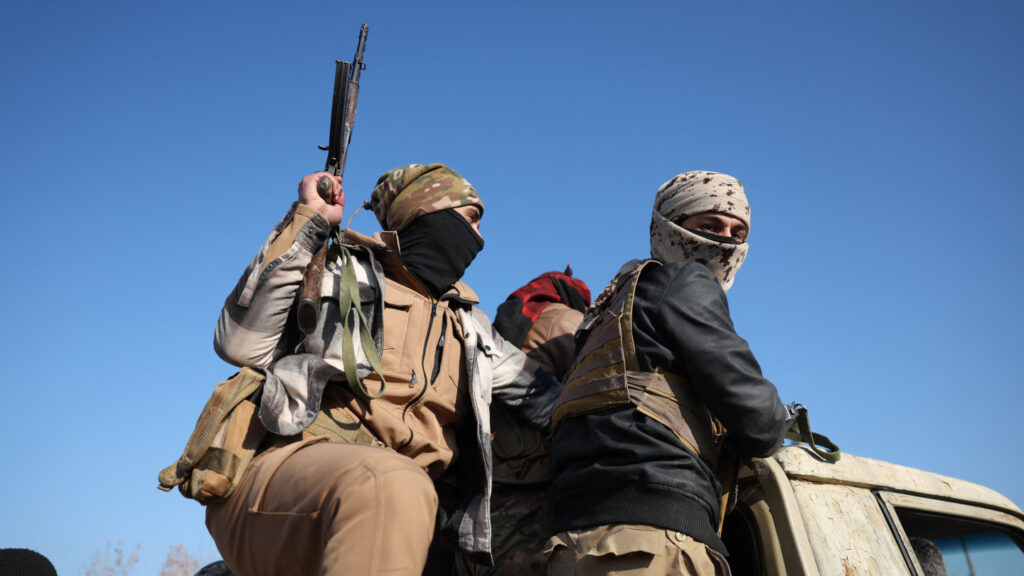
Turkey’s military and political backing of Damascus has proven decisive in strengthening the Syrian government’s hand against the SDF
Syria just experienced the deadliest clashes yet between the post-Assad interim government of President Ahmed Al-Sharaa and the Kurdish-led Syrian Democratic Forces (SDF).
Turkey reaffirmed its support of Damascus amid these clashes and offered its support. As the main military backer of the new Syrian government, Ankara could play a decisive role in helping Damascus mount any additional operations against the SDF.
“I hope it doesn’t come to that point … but when problems are not solved through dialogue, unfortunately, I see from here that the use of force is also an option for the Syrian government,” Turkish Foreign Minister Hakan Fidan said last Thursday.
Fidan’s remarks followed five days of fighting between Syrian government forces and the SDF in Aleppo’s Kurdish-majority Sheikh Maqsoud and Achrafieh neighbourhoods, which killed at least 24 civilians and displaced 150,000 people.
Government forces then advanced east, declaring all areas still controlled by the SDF west of the Euphrates River a “closed military zone”.
Over the weekend, government forces captured the towns of Deir Hafer and Maskanah east of Aleppo. On Sunday, these forces pushed into the strategic town of Tabqa and advanced into the SDF-held Arab-majority regions of Deir az-Zour and Raqqa and seized the Omar oilfield, the country’s largest, east of the Euphrates.
The government and SDF have agreed to an immediate ceasefire on all fronts, with Turkey’s military and political backing of Damascus proving decisive for the central government in its fight against the SDF.
‘One state, one army’
“Ankara expects Damascus to deal firmly with the SDF and to pursue a policy in line with Turkish interests,” Aron Lund, a fellow with Century International and a senior analyst at the Swedish Defence Research Agency, told The New Arab on Wednesday.
“I guess in that sense you could say Turkey has set up some red lines for Al-Sharaa’s government, even if they’re not going to state that in public,” he said. “Then again, I think Damascus and Ankara are actually pretty well aligned on this issue. Syria’s new rulers also want to weaken the SDF, and they don’t want a self-governing Kurdish region there.”
Wladimir van Wilgenburg, a freelance journalist and analyst specialising in Kurdish affairs, says Ankara has significant influence over Damascus.
“There’s close contact on a very regular basis, including military-to-military,” he told TNA in an interview on Thursday. “During the Aleppo operation, you saw before and after, there were many meetings with Turkish officials.”
A Turkish defence ministry spokesperson warned on Thursday that Ankara is prepared to fight the SDF alongside Damascus and even went as far as to say that Turkey and Syria are “one state, one army.”
“Ankara’s influence over Damascus remains strong as long as the Turkish government’s concerns align with those of the Al-Sharaa government,” Suleyman Ozeren, a lecturer at the American University and senior fellow at the Orion Policy Institute, told TNA on Friday.
“In other words, HTS is unlikely to act as Ankara’s proxy against the SDF if doing so does not serve Damascus’s interests,” he said. “That said, both Syria’s domestic dynamics and broader regional developments currently favour Turkey in recent weeks.”
Hayat Tahrir al-Sham is the name of the armed Islamist opposition group led by Al-Sharaa during the Syrian war, when he was known only by his nom de guerre, Abu Mohammed al-Jolani. Al-Sharaa officially disbanded HTS after triumphantly entering Damascus after Assad fled in December 2024.
Delayed integration
The Aleppo crisis followed the expired 31 December deadline for the 10 March integration agreement, co-signed by Al-Sharaa and SDF commander-in-chief Mazloum Abdi. It compelled the SDF and the affiliated civilian Democratic Autonomous Administration of North and East Syria (DAANES) to fully integrate into the Syrian government and military by the end of 2025.
The new deal introduced on Sunday similarly calls for the complete integration of the SDF. Damascus and the SDF previously disagreed on the form of integration, with the government insisting the SDF disband and join the military as individuals, while the SDF insisted it should join as units. Sunday’s agreement reiterates the government’s demand that the SDF join the military on an “individual” basis.
In a written statement, the Turkish Foreign Ministry said Ankara supports the agreement in the hopes that it will “promptly and effectively advance efforts to establish stability and security in the country on the basis of Syria’s territorial integrity and unity.”
Furthermore, it added, “Turkey will continue to support the Syrian government’s counterterrorism efforts and reconstruction work, provided they are carried out with an inclusive and integrative approach based on public consent.”
“The Aleppo clash was a serious blow to both the SDF and the DAANES administration,” Ozeren said. “First, they were unable to maintain their position in Aleppo, and Damascus gained confidence by defeating the SDF.”
Ozeren pointed out that while the SDF certainly lost momentum, Damascus also faced “clear constraints,” since the incumbent US administration was not likely to tolerate a war that destabilised Syria yet again.
Century International’s Lund anticipated the clashes after the initial Aleppo operation and expected both sides to be “negotiating alongside the violence or between the rounds of conflict”.
Furthermore, he described the Aleppo neighbourhoods as “low-hanging fruit” for government forces.
“They were basically an outgunned enclave, very hard to defend for SDF,” Lund said. “It was a logical place to escalate when the agreement expired, and Damascus wanted to put pressure on SDF, but it was also kind of its own thing, separate from the rest of the SDF-army frontline,” he added. “Taking those neighbourhoods didn’t shift the military balance much, in and of itself.”
Furthermore, unlike Sheikh Maqsoud and Achrafieh, Deir Hafer and Maskanah represented “a real defensive line” for the SDF since they “guarded the road to Raqqa” and oil infrastructure under SDF control. Seizing these areas represents “a threat to the wider northeast in a way that Aleppo City fighting did not,” Lund said.
“These are still fairly peripheral areas where the SDF is present more for military reasons than out of a commitment to the territory or the local population,” he added. “It’s not quite the same as going into their core regions.” Those areas, Syria’s Kurdish heartland, are situated east of the Euphrates.
A Turkish-backed offensive?
Wilgenburg pointed to SDF claims of new Turkish drone strikes and Turkish President Recep Tayyip Erdogan’s welcoming of the Aleppo operation as indications that Ankara provided at least some support for the Syrian government offensive.
Lund outlined how Turkey had several “available options to escalate”. Providing some air support to the Syrian government’s offensive east of Aleppo was “way down the ladder” compared to what Ankara could do in an all-out offensive.
“They could bring in lots of other resources, including ground troops, should they choose to,” he said. “But crossing those lines would also be likely to draw more international attention.”
Ozeren noted that while the government’s Aleppo operation may have “altered the landscape” in Syria, Ankara probably wouldn’t risk taking unilateral actions without first securing “tacit US consent.” Damascus and the SDF are also “walking on thin ice” when it comes to managing their respective relations with Washington.
The SDF and Syria’s new military both field sizable forces with tens of thousands of fighters. Wilgenburg noted that the latter recently recruited more people by integrating former opposition groups such as the Syrian National Army (SNA), which fought the SDF before, notably even after Assad’s ousting. Before Assad fled, the SDF had more fighters than HTS. That’s no longer the case.
If the present ceasefire agreement holds, the SDF’s integration may be inevitable, and likely on the terms of Damascus. If it collapses and fighting resumes, Turkey’s support for the Syrian government would probably tip the scales in its favour.
Ozeren noted that external support would prove decisive for both sides if they end up fighting a full-scale war. However, another civil war would undoubtedly prove calamitous for a country still recovering from its last one.
“Such a war could lead to broader instability across the country, including the south and west, potentially involving Druze and Alawite communities – an outcome the United States and European countries have sought to avoid since the collapse of the Assad regime,” he said.
Ozeren saw a “heightened risk” of another civil war during these clashes and warned that the “parties to such a scenario could lead to devastating consequences” for Damascus and the SDF.
As a result, he expected both sides to “initially try to walk a tight rope to avoid that.” Luckily for Syria, it seems that’s what they are now doing.