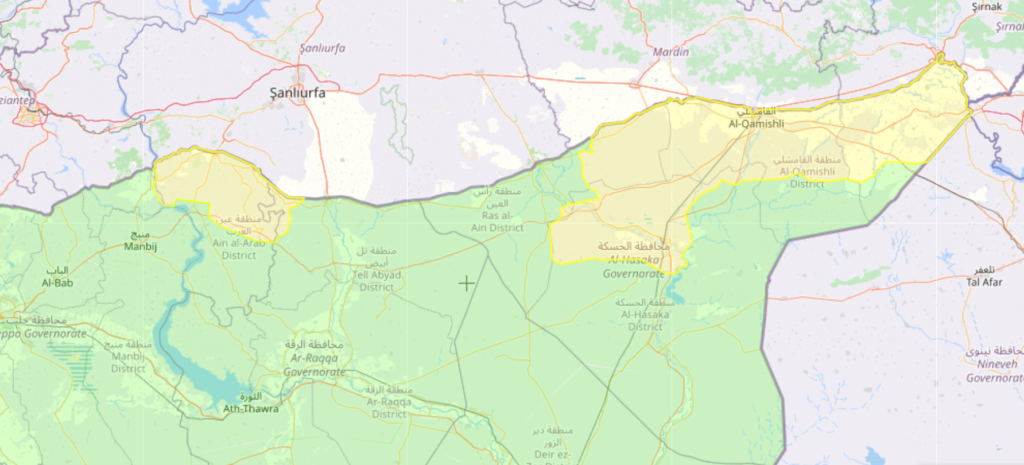
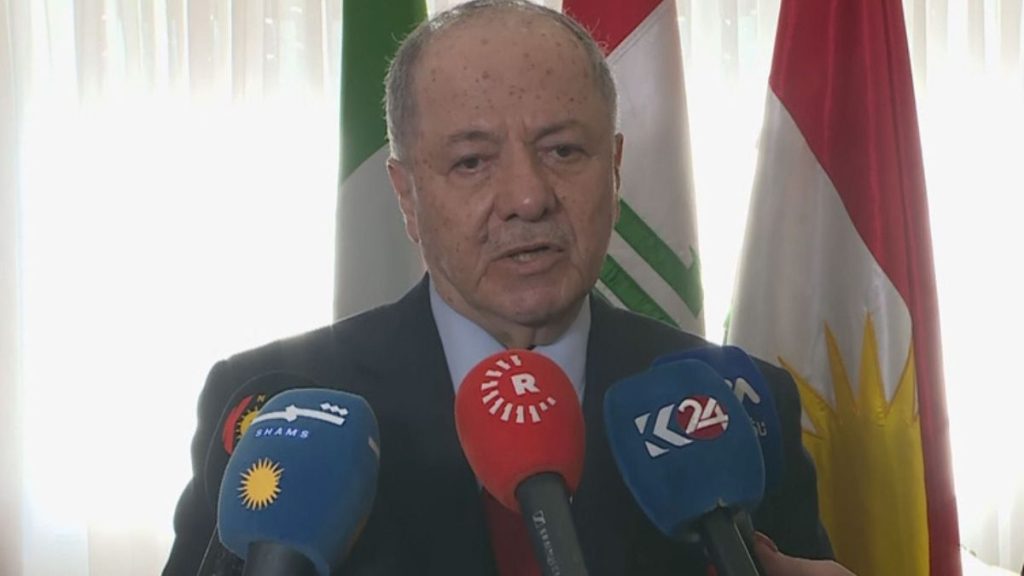
Kurdistan Democratic Party leader Masoud Barzani warned against any move to target Kobani (Ayn al-Arab), the last point held by the Syrian Democratic Forces (SDF) in eastern Aleppo’s countryside (northern Syria).
Speaking at a press conference in Italy on Friday, 23 January, Barzani said Kobani is “a Kurdish city that must not be touched,” adding that he would do “everything necessary if the Kurds are attacked.”
Barzani also said European officials he met pledged to support the Kurds and work to protect them, especially in the “Rojava” region, a term used by the Autonomous Administration to refer to northeastern Syria.
Aid readiness and a reminder of past military intervention
In remarks to Rudaw, Barzani said he was ready to exert every possible effort to support Kobani, stating, “If I had the chance as before, I would have sent forces to protect it.”
The comment referenced the role played by the Kurdistan Region of Iraq in backing the city during the Islamic State siege of 2014, when it helped open a military and political support front, alongside benefiting from the US led international coalition’s air cover via Turkish territory. This contribution was pivotal in halting the group’s advance.
Barzani said current conditions do not allow for repeating the same military scenario, but noted that relief roles could be activated, such as the Barzan charitable foundation, to support residents.
Barzani criticizes SDF management of the tribes file
Barzani commented on tensions in areas controlled by the SDF, saying part of the current problems relate to Syrian Arab tribes that were within SDF ranks.
He added that he had previously warned SDF commander Mazloum Abdi about the need to address conditions in predominantly Arab areas to avoid future crises.
A military source in the Syrian army told Enab Baladi that the rapid advance of Syrian forces was driven by local tribal support, with Arab tribes directly joining operations against the SDF and facilitating government forces’ entry into wide areas.
The source added that this support also helped secure control over Deir Ezzor and its oil fields in record time, interpreting the SDF’s mass withdrawals from several areas as a result of weak local backing in the largely Arab Jazira region.
Kurdish humanitarian appeals and political moves
A Kurdish Red Crescent team in Kobani issued an urgent appeal to humanitarian organizations and the United Nations for immediate intervention, warning of a deteriorating humanitarian situation in the city. The appeal said Kobani has, for days, been facing what it described as a military campaign and a tight siege imposed by armed factions affiliated with the Syrian government, according to a statement cited by SDF media official Farhad Shami.
The appeal said the siege has prevented the entry of food, fuel, and basic supplies, forcing hundreds of families to flee and shelter in abandoned buildings after electricity and communications were cut. It described the situation as “catastrophic,” recalling the Islamic State’s 2014 siege of Kobani.
As Kurdish political and diplomatic activity increased in support of Kobani, the Kurdish National Council (ENKS) said it was in contact with the Syrian government to open a humanitarian corridor to the city.
ENKS representative in Damascus Mahabad Tizyani said the siege imposed by the Syrian army is placing heavy pressure on residents, adding that they contacted every responsible party to lift it. He said they are also working to extend the existing ceasefire between the SDF and the Syrian army.
Kurdish media outlets quoted the representative as saying there is an opportunity to open a humanitarian corridor if the ceasefire is extended, but that the file is complicated and Damascus has not yet set a date.
These statements and moves come days after the Syrian Presidency announced on Tuesday, 20 January, a new understanding with the SDF over the future of al-Hasakah Governorate (northeastern Syria). Under the understanding, the SDF was given four days to consult on a detailed plan to integrate areas in practice.
The Syrian Defense Ministry and the SDF also announced their commitment to a four day ceasefire in line with these understandings.
Government forces have not entered predominantly Kurdish areas, most notably Qamishli, al-Hasakah, and Kobani, as negotiations continue over how these areas will be administered and how government institutions will enter them.