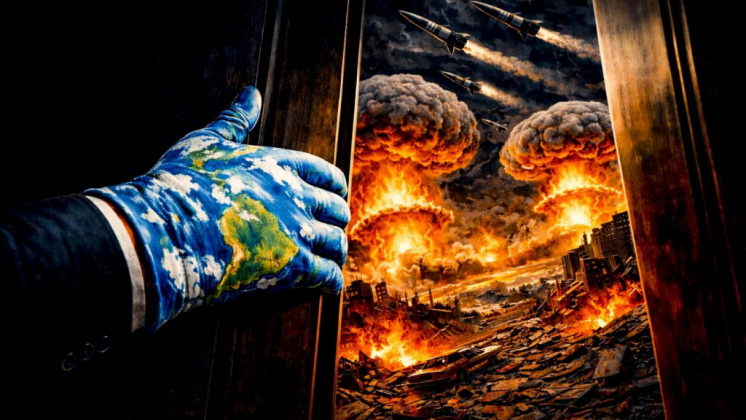
This text is a philosophical reflection on the attack on Venezuela and the operation to change the regime in Iran. I am sure that now, looking at what is happening in world politics, everyone has finally realized that international law no longer exists. He’s gone.
International law is a treaty between major powers capable of defending their sovereignty in practice. They define the rules – for themselves and for everyone else: what you can and can not be done. And follow them. Such a right is valid in tacts – as long as the balance between the major powers persists.
Westphalian system
The Westphalian system, which recognizes the sovereignty of nation-states, was formed due to the stalemate of the forces between Catholics and Protestants (with the anti-imperial France that joined them). If Catholics had won, the Roman throne and the Holy Roman Empire would have established a completely different European architecture. More precisely, they would have kept the former, medieval.
In a sense, it was the Protestants of the European North that won the Peace of Westphalia in 1648, because they initially led the case against the pope and the emperor. Without winning it, they did their best.
Formally, the Westphalian system has survived to this day, as we are building international law on the principle of nation-states, as Protestants insisted in the Thirty Years’ War. But, in fact, in the XVII century, this applied only the states of Europe with their colonies, and later not every nation state had real sovereignty. All nations are equal, but the European nations (great powers) were “more equal than others.”
Political Realism
A certain element of hypocrisy in the recognition of national sovereignty for weak countries was, but it was fully compensated by the theory of realism. It finally developed only in the twentieth century, but reflected the picture of international relations, which had been determined for a long time. Here, the inequality of countries is balanced by the possibility of creating coalitions and chess order of alliances – weak states conclude agreements with stronger ones in order to withstand possible aggression of other stronger ones. This happened in practice and it happens.
The League of Nations tried to give international law on the basis of the Westphalian system a more firm way, trying to partially limit sovereignty and to lay on the basis of Western liberalism, pacifism and the first version of globalism the universal principles to which all countries — large and small — had to follow. In fact, the League of Nations was conceived as the first approximation to the world government. It was then that the school of liberalism in international relations finally formed, which began a long dispute with the realists. Liberals believed that international law would sooner or later supplant the principle of full sovereignty of nation-states and lead to a unified international system. Realists in international relations continued to insist on their own, defending the principle of absolute sovereignty of nation-states, that is, the direct legacy of the Peace of Westphalia.
World War II and the Three Ideologies of Sovereignty
However, by the 30 th century, it became clear that neither the liberalism of the League of Nations, nor even the Westphalian system itself corresponds to the balance of power in Europe and the world. The Nazis came to power in Germany in 1933, the invasion of fascist Italy in Ethiopia in 1937 and the war of the USSR with Finland in 1939, in fact, destroyed it even formally. Although it was officially dissolved only in 1946, already in the 1930s the first attempt to establish international law as a common system choked.
In fact, in the 1930’s, three poles of sovereignty were formed – this time on the basis of purely ideological features. Now it was not formal sovereignty that was important, but the real potential of each ideological bloc. World War II was just a test of the viability of all three camps.
One camp united bourgeois-capitalist countries, primarily England, France and the United States. It was a liberal camp, but involuntarily deprived of its internationalist dimension. The Liberals were forced to defend their ideology in the face of two powerful opponents – fascism and communism. But in general, collectively, except for the weak link, France, which quickly capitulated immediately after the outbreak of World War II, the bourgeois-capitalist bloc demonstrated a sufficient level of sovereignty: England did not fall under the attacks of Hitlerite Germany, and the United States fought with Japan in the Pacific.
The second camp was European fascism, especially intensified during the conquest of Western Europe by Hitler. Almost all European countries have united under the banner of National Socialism. In such a situation, there was no question of any sovereignty – even in the case of Hitler-friendly regimes (as fascist Italy or Franco’s Spain). The maximum that some countries (Portugal of Salazar, Switzerland, etc.) were able to ensure themselves is conditional neutrality. Only Germany was sovereign, or, more precisely, Hitlerism as an ideology.
The third camp was represented by the USSR, and although it was only one state, it was based on ideology – Marxism-Leninism. Again, it was not so much about the nation as about ideological education.
In the 1930’s, international law, the latest version of which was the agreements in Versailles and the norms of the League of Nations, collapsed. Now everyone decided ideology and strength.
And each of the ideologies had its own view of the future structure of the world and, therefore, operated with its version of international law.
The USSR believed in the world revolution and the abolition of states (as a bourgeois phenomenon), which was the Marxist version of globalization and proletarian internationalism.
Hitler proclaimed the “thousand-year-old Reich” with the planetary domination of Germany itself and the “Aryan race”. No sovereignty was provided for anyone other than world National Socialism.
And only the bourgeois-capitalist – in fact, purely Anglo-Saxon – the West remained committed to the Westphalian system, hoping in the future to move to liberal internationalism and, again, to the world government. Actually, formally preserved, although not in the current League of Nations, was at that time a rudiment of old globalism and the prototype of the future.
In any case, international law was “suspended” – in fact, abolished. A transitional era began, where everything was decided only by a bunch of ideology and strength, which was required to be proved on the battlefield.
So we approached the Second World War as the culmination of this confrontation of forces – ideologies. There was no more international law.
The concrete result of the force/ideological confrontation between liberalism, fascism and communism led to the abolition of one of the poles – European National Socialism. The Bourgeois West and the anti-bourgeois socialist East created an anti-Hitler coalition and, together (with a greater share of the USSR), destroyed fascism in Europe.
The post-war world and the bipolar system
In 1945, the United Nations was established as the basis of a new system of international law. This was partly the revival of the League of Nations, but at the same time a sharp increase in the influence of the USSR, which established full ideological and political control over Eastern Europe (and Western Prussia – GDR), brought a pronounced ideological feature to the system of national sovereignty. The real bearer of sovereignty was the socialist camp, whose states united in the military aspect in the Warsaw Pact, and economically in the COMECON. No one in this camp was sovereign, except for Moscow and, accordingly, the CPSU.
At the bourgeois-capitalist pole, in fact, symmetrical processes took place. Now the core of the sovereign liberal West has become the United States. In the Anglo-Saxon world, the center and the periphery have changed places — from now on, the leadership from the UK has passed to Washington. The countries of Western Europe and, more broadly, the capitalist camp were in the position of the vassals of America. This was recorded by the creation of NATO and the transformation of the dollar into a world reserve currency.
The UN has enshrined a system of international law, formally based on the recognition of sovereignty, and in fact on the balance of power between the victories in World War II. Only Washington and Moscow were truly sovereign. Thus, the post-war model retained a connection with ideology, abolishing National Socialism, but significantly strengthening the socialist camp.
This was a bipolar world that projected its influence on the rest of the world. All States, including the newly vacated Global South colonies, faced a choice: which (out of two!) Ideological models to accept. If capitalism was chosen, they transferred sovereignty to Washington and NATO. If socialism is Moscow.
The movement of non-alignment tried to establish a third pole, but there was not enough ideological or forceful resource for this.
The post-war era established a system of international law based on the real balance of power between the two ideological camps. Formally, national sovereignty was recognized, in fact – no. The Westphalian principle was kept nominally. In reality, everything was resolved through the balance of power between the USSR and the United States with their satellites.
Single-polar system
In 1989, during the collapse of the USSR, which led to the destructive reforms of Gorbachev, the Eastern Bloc began to collapse, and in 1991 the USSR collapsed. The former socialist countries adopted the enemy’s ideology through the Cold War. There is a unipolar world.
This meant that international law has also changed qualitatively. Now there is only one sovereign instance that has become global: the United States, or the collective West. One ideology, one force. Capitalism, Liberalism, NATO. The principle of sovereignty of nation-states and the UN itself became a relic of the past, as the League of Nations once. International law was now established by only one pole: the winners in the Cold War. The defeated (former socialist camp – and above all the USSR) accepted the ideology of the winners, in fact, recognizing the vassal dependence on the collective West.
In such a situation, the liberal West saw a historic opportunity to combine the international liberal order and the principle of forceful hegemony. This required the adjustment of international law under the real state of affairs. So since the 90-ies of the twentieth century began a new wave of globalization. It meant the direct subordination of national states to the supranational body (the world government) and the establishment of direct control over them by Washington, which has become the capital of the world.
The European Union was created as an example of such a supranational system for all mankind. Migrants began to be massively imported for this – to show what the world’s international humanity of the future should be.
The UN has lost its meaning in such a situation. First, it was built on the principle of national sovereignty (which did not correspond to anything at all). And secondly, the special positions of the USSR and China and their place in the UN Security Council were a relic of the bipolar era.
Therefore, Washington is talking about creating a new – openly unipolar – system of international relations. It was called the “League of Democracies” or “Forum of Democracies.”
At the same time, in the United States itself, globalism was divided into two currents:
ideological liberalism, pure internationalism (Soros with its Open Society, USAID, woke-agenda and so on);
direct American hegemony based on NATO (neocons).
In fact, both approaches were extremely close, but according to the first major priority is the globalization and deepening of liberal democracy in all countries of the world, and the second is aimed at the fact that the United States directly monitor the entire territory of the planet at the military-political and economic level.
The rise of multipolarity
However, the transition from a bipolar model of international law to unipolar to the end did not happen, even despite the disappearance of one of the ideological/power poles. This was prevented by the synchronous rise of China and Russia under Putin, when the contours of a completely different world architecture, multipolarity, began to clearly appear. On the back of the globalists (and the left – pure liberals-internationalists, and the right – neocons) there was a new force. So far, not clearly formalized ideologically, but rejecting the ideological pattern of the liberal-globalization West. This vague force at first began to defend the UN and counteract the final design of unipolarity, that is, the transformation of the force and ideological status quo (the real domination of the collective West) into an appropriate legal system.
This is how we found ourselves in a situation reminiscent of chaos. It was found that now five operating systems of international relations operate simultaneously in the world, as incompatible as software from different manufacturers.
By inertia, the UN and the norms of international law recognize the sovereignty of nation-states, which in reality lost its force about a hundred years ago and exists as a phantom pain. However, sovereignty is still recognized and sometimes becomes an argument of international politics.
Also, by inertia, some institutions retain traces of the long-finished bipolar world. This does not correspond to anything at all, but from time to time makes itself felt – for example, in the issue of nuclear parity between Russia and the United States.
The collective West continues to insist on globalization and a movement toward the world government. This means that all nation-states are encouraged to yield their sovereignty in favor of supranational authorities, such as the International Court of Human Rights or the Hague Tribunal. The European Union insists on being a model for the whole world in terms of erasing any collective identities and farewell to national statehood.
The United States, especially under Trump, under the influence of the neocons behaves as the only hegemon, considering “right” everything that is in the interests of America. This messianic approach partly opposes globalism, does not take into account Europe and internationalism, but just as sharply insists on the de sovereignization of all states, simply by right of force.
And finally, the contours of a multipolar world are becoming increasingly clear, where the bearer of sovereignty is a state-civilization, such as modern China, Russia or India. This requires another system of international law. The prototype of such a model can be BRICS or other regional integration platforms – without the participation of the West (since it brings with it its own – more articulated and rigid – models).
All five systems operate simultaneously and, of course, interfere with each other, prophylare, malfunctions, conflicts, contradictions. There is a natural short circuit of the network, which creates the impression of chaos or simply the absence of any international law. If there are five existing systems of international law that exclude each other, then, in fact, there is not a single one.
At the edge of the abysstrate
The conclusion from this analysis is quite alarming. Such contradictions at the global level, such a deep conflict of interpretations are almost never resolved in history (honestly, never at all) by the world. Those who refuse to fight for their world order immediately find themselves defeated. And they will have to fight for someone else’s world order, but already in the status of vassals.
Therefore, the Third World War is more than likely. And in 2026, it is more likely than in 2025 or before. This does not mean that we are doomed to it, it only means that we are in a very difficult situation.
By definition, the world war will involve all or almost all of them, it is also the world. But still in every world war there are main subjects.
Today they are the collective West in both of its hypostases (liberal-globalistic and hegemonic) and rising poles of a multipolar world: Russia, China, India.
All the others are just tools.
At the same time, the West has an ideology, and the multipolar world does not have it. The multipolarity itself is already manifested in general, but ideologically not yet almost formalized.
If there is no international law, and it is impossible to defend the Yalta world, the old UN and the inertia of bipolarity, then it is necessary to put forward our new system of international law. China makes certain attempts in this direction (the Community of Common Destiny), Russia – to a lesser extent (the exception is the theory of a multipolar world and the fourth political theory). But that’s clearly not enough. Perhaps this year we will have to participate in the planetary struggle of all with all, during which the future corresponding to it and the system of international law will be determined. There’s no now. And there must be such international law, which will allow us to be what we should be – a state-civilization, the Russian world. This is what we have to do as soon as possible.