
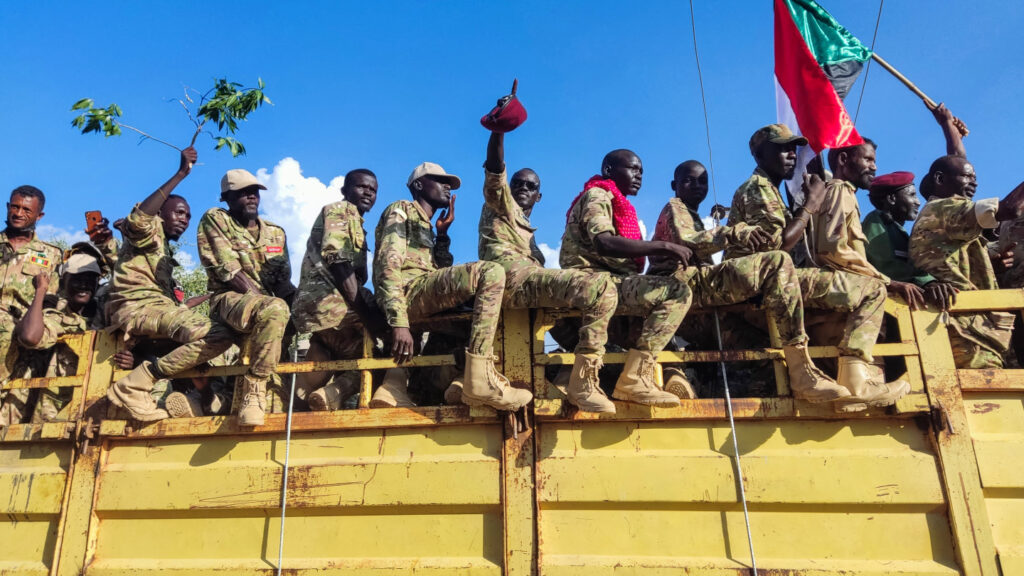
After El-Fasher’s fall, Egypt faces the choice of intervening in a war against UAE proxies, or standing by as its ‘red lines’ in Sudan fade into irrelevance
For nearly a thousand days, Egypt’s posture toward the civil war in Sudan was one of “strategic patience,” as Egypt’s Foreign Minister Badr Abdelatty framed it.
That ended in late December. Following a visit by General Abdel Fattah al-Burhan, the leader of the Sudanese Armed Forces (SAF), the Egyptian presidency issued its most significant statement of the war in which it drew four “red lines”.
They entailed the preservation of Sudan’s territorial unity, the rejection of “parallel entities” (a direct swipe at the Rapid Support Forces, or RSF), the protection of “state institutions,” and a categorical refusal to allow any part of Sudan to secede.
Most tellingly, Cairo invoked its 1976 joint-defence pact with Khartoum, signalling the potential to get involved in the conflict militarily.
Egypt’s statement comes as its partner on the ground, the SAF, reels from a string of battlefield reversals since the fall of El-Fasher in October 2025. That defeat solidified the RSF’s dominance in Darfur and triggered a surge of aggressive RSF advances into the adjacent Kordofan region, the conflict’s current epicentre.
Yet, despite the chaos on Egypt’s southern border, there is a school of thought that posits that Egypt has reaped significant benefits from Sudan’s agony. Ahmed Kodouda, Senior Technical Advisor at Impact Policy Group and a former official in Sudan’s transitional government, observes that the war has provided a significant “silver lining” for Egypt. “Cairo has managed the crisis to its advantage so far,” Kodouda told The New Arab.
In May 2023, Cairo scrapped all customs duties on gold imports. The results were immediate and massive. Official figures suggest a gold export boom in Egypt that reached a staggering 2,746% jump in early 2025 compared to the previous year.
“Egypt’s gold reserves have increased, which is likely a result of increased gold smuggling from Sudan,” Kodouda told TNA.
This influx of bullion has acted as a crucial stabiliser for the Egyptian pound. By facilitating the export of this ‘recycled’ gold to hubs like Dubai and Zurich, Cairo has secured a steady stream of hard-currency liquidity it desperately needs as it battles its own economic troubles.
But Khaled Mahmoued, a veteran Egyptian journalist and analyst, dismisses the idea that Egypt wants a fractured neighbour. For Mahmoued, the long-term threat of a “militia state” on Egypt’s southern border far outweighs the short-term profits that come from smuggled gold or captive markets for Egyptian goods.
He recalled to TNA Cairo’s early warnings to the Sudanese leadership regarding the RSF leader, Mohamed Hamdan Dagalo, known as Hemedti: “You are building a state within a state. You are raising a lion that will eventually eat you.”
When President Abdel Fattah al-Sisi speaks of “red lines,” regional memory immediately drifts back to June 2020. At that time, Egypt declared the Sirte-Jufra axis in central Libya an inviolable marker.
Cairo massed troops on the border, secured parliamentary authorisation for intervention, and defined a clear, geographical line that Turkey-backed forces in Tripoli dared not cross. It locked Libya into a state of ‘no war, no peace’ that prevails to this day.
The circumstances in Sudan, however, offer few parallels. Beyond the absence of a neat, defendable corridor, the regional calculus has turned decisively against Cairo’s interests.
“The UAE is on the other side [of the war, in opposition to Egypt], which wasn’t the case before. Secondly, the Americans – who took the red lines on Libya seriously before – are not taking them seriously on Sudan,” Emadeddin Badi, a conflict analyst and Senior Fellow at the Global Initiative Against Transnational Organized Crime, told TNA.
This situation has created a geopolitical headache for Cairo. The UAE stands accused by conflict investigators and high-ranking American lawmakers and officials, including Secretary of State Marco Rubio, of supplying the RSF with advanced weaponry, drones, and logistical support – charges Abu Dhabi vehemently denies and Washington has done little to address.
Egypt, on the other hand, has been increasingly vocal in its support for the SAF. Cairo’s foreign minister recently described it as being “at the heart” of Sudan’s national institutions, the collapse of which Egypt will “not accept.”
This has created tensions between Egypt and the UAE, who are otherwise close allies. The Emirates remains a crucial financial lifeline for the Egyptian government.
Meanwhile, the view from the RSF’s “parallel government” in its base of Nyala, South Darfur is predictably furious over Egypt’s bellicose rhetoric. In a recent interview, al-Basha Tbaiq, an RSF adviser and spokesperson, described the Egyptian statement as “disappointing.”
“Egypt looks at Sudan as a backyard and as one of the Egyptian provinces,” Tbaiq said, framing Cairo’s interest as a relic of an “old colonial mentality” that began when Muhammad Ali Pasha, the Albanian mercenary turned ruler of Egypt, sent his armies south in 1820.
This conquest started a period of dominance and transitioned into joint rule with the British until 1956, when Sudan gained its independence.
For the RSF, Egypt’s current policy is merely a continuation of this history, and the SAF, in its framing, is a mere tool of Egypt’s hegemonic ambitions.
Hemedti himself has repeatedly accused the Egyptian Air Force of direct intervention, specifically claiming that Egyptian jets struck his forces during the 2024 battle for Jebel Moya in Sennar state.
While Egypt’s Foreign Minister dismissed these claims as “pure lies,” the RSF leader continued to harden his tone, warning a year later that the “airports of neighbouring countries “are “legitimate targets” for his forces if they continue to be used as launchpads for strikes against the RSF.
Indeed, the relationship between the RSF and Egypt has soured remarkably since Sudan’s civil war erupted. Its opening act at Merowe airbase in northern Sudan involved the RSF parading over 170 captured Egyptian soldiers who had been in Sudan for joint drills with the SAF.
Despite the turbulence of this episode, Cairo initially sought to mediate between the SAF and the RSF. But once Hemedti accused Egypt of “treachery”, it demoted the RSF from a political partner to a “militia” in its official statements. This partisan shift has, by consequence, effectively cracked the “Quad” – the US, Saudi, UAE, and Egyptian mediation group.
In recent months, Cairo and Riyadh have drawn closer. Following a visit to Egypt last week by the Saudi foreign minister, Prince Faisal bin Farhan Al Saud, both Egypt and Saudi Arabia openly declared that they share “identical views” on Sudan and Yemen – two theatres where the Saudi-Emirati “brotherhood” has reached a breaking point.
For Saudi Arabia, state failure in Sudan is a disruption to its Red Sea mega-projects, but for Egypt, it is a terminal threat. Cairo is bound to its neighbour through deep institutional army ties, the vital flow of the Nile and a long, porous 1,200km border, through which over one million Sudanese have crossed since war erupted in April 2023. It is therefore crucial to decipher what Egypt’s “red lines” actually look like.
If the RSF pushes back into the Nile valley, Cairo is, according to many, unlikely to send its own troops or jets into the fray. “I don’t foresee direct intervention except in very specific, critical stages,” analyst Khaled Mahmoued told TNA, adding that the details are “subject to classified military considerations”.
To other observers, Cairo’s forceful rhetoric arrived long after the damage was done. By the time the statement from the Egyptian presidency was issued, the markers of Sudan’s territorial integrity and sovereignty were already being dismantled.
“In terms of the red lines… virtually all of them, I would say, have been crossed technically in some way, shape, or form,” notes Emadeddin Badi, the conflict analyst. A number of events already prove this, he explained.
Firstly, for months, the RSF had already been busy with the business of state-building, appointing local governors and crafting parallel administrative institutions to chip away at the internationally recognised SAF-led government in Port Sudan.
Secondly, in June 2025, Hemedti’s forces captured the “border triangle” – where the frontiers of Sudan, Egypt, and Libya meet. This placed the RSF squarely on Egypt’s border. Even worse, Egypt serves as one of Field Marshal Haftar’s chief benefactors, but his sons, Saddam and Khaled, have reportedly ignored Cairo’s national security warnings.
Instead, they have allowed eastern Libya to become the main supply line for the RSF – the very “militia” Egypt is now desperate to contain.
For now, in addition to diplomatic pressure, Cairo’s preferred toolkit will likely remain surgical and deniable: intelligence, training, and weapons. Several reports suggest that these forms of support have already been flowing to the SAF from Egypt for much of the war.
The coming months will undoubtedly test Egypt’s ‘red lines.’ The true driver for its announcement was the fall of El-Fasher, a defeat that has had far-reaching impacts on the geography of the war.
It has allowed the RSF to shift its attention, its manpower, and resources towards the east and north, putting the capital and the demographic centres of the country at risk once again. For Egypt, another RSF advance there means another exodus, another million (or more) refugees at its gates.
If the RSF scores more victories on the ground in the Kordofan region and pushes towards the Nile Valley, Cairo will face a difficult choice of intervening directly and risking getting sucked into a brutal war with the UAE’s proxies, or standing by as its ‘red lines’ are quietly erased.