
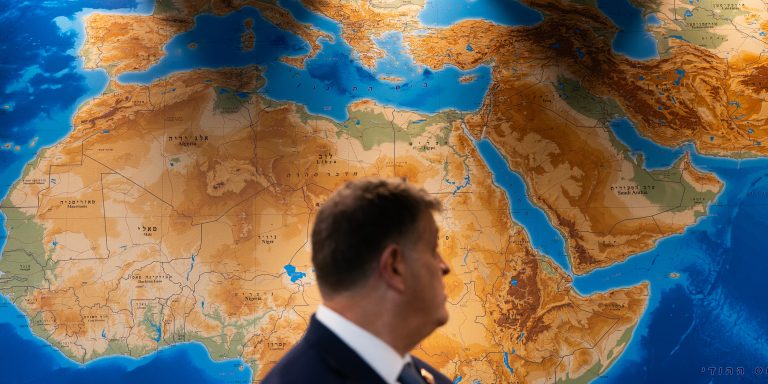
The Middle East region could transition in 2026 to peace and stability or, perhaps more likely, backslide into regional conflagration.
Conflicts in Gaza, Lebanon, Libya, Sudan, and Yemen, as well as political divisions in Yemen, Iraq, and Syria, are unlikely to fully resolve in 2026 and will require consistent attention from U.S., regional, and global diplomats.
The Trump team will struggle in 2026 to “pivot” from the Middle East to other regions, in part because the U.S. has become the broker, mediator, and guarantor of ceasefires in Lebanon and Gaza, and security cooperation between Israel and Syria.
The potential threat of additional military action by Israel and the U.S. against Iran will loom in 2026, but Iran might emerge as a bright spot for regional stability if expanding protests there unexpectedly oust the regime.
Global officials hope that the ceasefire put in place in Gaza in October will pave the way for the Middle East to be quiet in 2026. But many experts expect that such hopes will be thwarted by a region replete with unresolved conflicts, routine violations of red lines, and power struggles among allies, particularly the Kingdom of Saudi Arabia and the United Arab Emirates (UAE). Any one conflict, if it escalates, threatens to engulf the region in major new violence. The Gaza war seems poised to resume as Hamas refuses to disarm, as required by the Trump peace plan, and Israel delays any further Gaza withdrawals until all provisions of that plan are fully implemented. The Iran-backed Houthis in Yemen are almost certain to resume their attacks on commercial shipping in the Red Sea if the Gaza fighting flares anew. Israel will continue to strike Hezbollah positions throughout Lebanon almost daily in 2026, despite a November 2024 ceasefire, to pressure the Beirut government to disarm the group’s militia. On the other hand, U.S.-brokered security understandings and intelligence sharing between Israel and the new government in Damascus, announced in December, might reduce Israel’s encroachments on Syrian sovereignty. No pacts with its neighbors, however, will cause Israel to alter its fundamental post-October 7 reliance on hard power against perceived or potential adversaries anywhere in the region in 2026.
Meanwhile, throughout 2026, several of the region’s countries will remain failed states with competing power centers, including Libya, Yemen, and civil war-ridden Sudan. In Libya and Yemen, UN, U.S., European, and regional diplomats have made little or no progress persuading contending factions to reach permanent agreements that would restore unified political structures. The internecine warfare in Sudan between the Sudan Armed Forces and the Rapid Support Forces militia will continue to rage, causing massive civilian casualties and drawing limited but significant military involvement from outside actors, including Egypt, Saudi Arabia, the UAE, and Russia.
2026 will likely also see Yemen further divide as factions in southern Yemen — both of which oppose the Iran-backed Houthi movement that controls north and central Yemen — have begun contesting each other to control southern Yemen, and could possibly secede entirely. The conflict has drawn their respective backers, Saudi Arabia and the UAE, both allies of each other and of the U.S., into a limited conflict as part of the UAE’s effort to expand its regional influence across the Red Sea. Other governments in the region, including Iraq and Lebanon, will still struggle in 2026 to exercise a monopoly of armed force in their territories against Iran-backed non-state actors that have the potential, on their own, to provoke war with Israel or other regional states. These same governments, at the same time, continue to calibrate their policies to avoid setting off civil conflict with ethno-sectarian supporters of the militia-based groups.
The United States is likely to remain the key outside actor in the region in 2026 and beyond, despite the stated intent of the Trump administration, as expressed in its National Security Strategy (NSS) released in December, to “pivot” from the Middle East. Trump’s team seeks to refocus policy toward current and near-term threats in other regions, particularly East Asia and the Western Hemisphere. But the intended Trump pivot is based on a U.S. assessment that the various conflicts in the region are either fully resolved or well on their way to complete resolution — an estimate widely challenged by global experts and many others.
In 2026, the continued paramount role of the U.S. as a security guarantor for many of the region’s countries, particularly the Arab Gulf monarchies, and as a broker and mediator of the region’s conflicts, will compel regional governments to adjust their policies to align with Washington’s actions and statements. Yet neither Russia nor China has conceded its interests in the Middle East, and both powers will seek opportunities to exploit the region’s conflicts and divisions to undermine U.S. hegemony. China’s interests in the region have to date mostly centered on commerce and securing oil supplies from the region’s exporters; but in 2026, Beijing will also continue to pursue security partnerships with several states in the region.
If the Trump team intends to de-emphasize the Middle East, its own efforts to resolve the region’s conflicts will likely frustrate that objective. Trump and his team have further entangled the U.S. in the region by establishing themselves as guarantors and arbiters of regional agreements. To try to resolve the conflict in Gaza, for example, Trump’s Gaza peace plan has assigned him to head a “Board of Peace” that will supervise a yet-to-be-established technocratic government in Gaza. Trump’s team has also established the U.S. military as nominal commander of an International Stabilization Force (ISF) that is to serve as an interim security force for Gaza, even as U.S. officials insist no U.S. military personnel will serve on the ground inside Gaza. Trump also inherited from the Biden administration, and has continued, the role of chairman of a Lebanon-Israel ceasefire monitoring committee — a role challenged by Israel’s nearly daily violations of the November 2024 truce.
Yet as 2026 began, the Trump team registered an early success by forging a “joint mechanism” for intelligence-sharing and coordinating military de-escalation between Israel and the post-Assad government of Ahmad al-Sharaa in Damascus. The pact is short of a hoped-for broad Israel-Syria security agreement, let alone a broader peace between them. But Israel and Syria released an upbeat joint statement saying: “The mechanism will serve as a platform to address any disputes promptly and work to prevent misunderstandings.”
The limited Syria agreement notwithstanding, the refusal by both Hezbollah and Hamas to disarm will continue to fuel Israel’s post-October 7 reliance on hard power, and its skepticism of collective security arrangements and diplomatic assurances. Some Arab leaders now consider Israel a greater threat to the region than the Islamic Republic of Iran, a perception sparked by Israel’s September crossing of a seemingly sacrosanct red line — the bombing of a Hamas compound in the key U.S. ally, Qatar. Some of Israel’s actions, including its efforts to carve out a secure buffer zone in Syria, conflict with U.S. priorities. Israel’s policies, as well as the broader revulsion at the enormous number of Palestinian deaths caused by its war against Hamas in Gaza, render it unlikely that Trump will succeed in 2026 in expanding the 2020 Abraham Accords normalizations of relations with Israel. Israel is unlikely to undertake the concessions on Palestinian statehood needed to convince Saudi de facto leader Mohammed bin Salman (MBS), for example, to normalize relations with Israel. But despite criticism of its close and organic relationship with the Netanyahu government, the Trump team shows no signs it will openly break with Israel or even sharply criticize its actions in 2026.
Also left open for 2026 is whether the region’s conflicts will undermine Trump’s efforts to reorient the region from security dynamics to economic integration and cooperation — within the region and with the larger U.S. economy. Trump’s priority is reflected in the NSS, which states that the Administration envisions more closely integrating Middle Eastern countries into key U.S. industries, including artificial intelligence (AI), rare-earth mineral processing, nuclear energy, and defense technologies. The economic opportunities provided by the region, particularly the wealthy Gulf states of Saudi Arabia, Qatar, and the UAE, were the centerpiece of Trump’s trips to the region early in both his first and his current term in office.
It is the policy toward Iran on which Netanyahu and Trump will remain most closely aligned in 2026. As 2025 drew to a close, all indications were that Trump views a new nuclear agreement with the Islamic Republic as unachievable. Iranian leaders have rejected the core U.S. demand that Iran end its enrichment of uranium, and Tehran has continued to suspend cooperation with International Atomic Energy Agency (IAEA) monitors by excluding them from inspecting the uranium enrichment facilities damaged by the June U.S. and Israeli Twelve-Day War air campaigns. Nor has Tehran divulged the fate of Iran’s stockpile of 60 percent enriched uranium. Numerous reports also indicate the regime is actively working to restore its ballistic missile arsenal to pre-Twelve Day War levels. Suggesting that either or both leaders might strike Iran again in 2026, perhaps early in the year, Trump signaled he would not only green light another Israeli attack on Iran but potentially even join that action. Asked about the U.S. stance when meeting with Netanyahu in South Florida on December 29, Trump answered: “If [Iran] will continue with the missiles – yes. [And if they continue with] the [production of] nuclear [capabilities] – fast. One will be yes, absolutely. The other, we’ll do it immediately.”
Yet it is also in Iran that regional and global leaders might achieve a major advance in Middle East stability in 2026. In the waning days of 2025, a significant uprising began, at first citing deteriorating economic conditions but almost immediately evolving into a broader demand for wholesale regime change. An exact gauge of the strength of the uprising against the regime’s ample security apparatus remained unclear in the first week of 2026, but the protests have grown and, in many cases, become violent since they began on December 28. A replacement of the regime would likely concern many Arab leaders who fear long-term instability in Iran and uncertainty about the policies of a new regime that might emerge in Tehran. However, the U.S., most of its Arab allies, and Israel would welcome the removal of Iran’s current regime as a significant stabilizing influence, as that outcome would surely deprive Iran’s Axis of Resistance coalition of ongoing support.