An internal Hamas assessment suggests the EU’s former top diplomat in the Palestinian territories pursued a personal approach to Gaza that crossed Brussels’ red lines
An internal Hamas document seen by Euractiv suggests that the EU’s former envoy to the Palestinian territories, Sven Kühn von Burgsdorff, pursued positions that diverged from official EU policy and were viewed favourably by Hamas leaders in Gaza.
Kühn von Burgsdorff served as the EU’s ambassador to the Palestinian territories and the Gaza Strip from January 2020 to July 2023.
During his tenure, he repeatedly drew criticism from Israeli officials and within the EU for positions seen as out of step with Brussels’ guidelines – including assurances to Palestinian NGOs found to have employed terrorists that they need not worry about losing EU funding, despite stricter anti-terror financing rules.
Paragliding in Gaza
The controversy peaked in July 2023, shortly before he left his post, when Kühn von Burgsdorff went paragliding in Gaza. In video footage from the Hamas-controlled enclave, he spoke enthusiastically of a “free Palestine”. Weeks later, Hamas carried out its 7 October attack on Israel, killing more than 1,000 people and abducting around 250 others.
Now, an internal Hamas document seized by the Israeli military during its subsequent campaign in Gaza suggests that Islamist leaders in the enclave held the EU envoy in high regard. The Jerusalem-based NGO Monitor analysed the document and shared its findings with Euractiv.
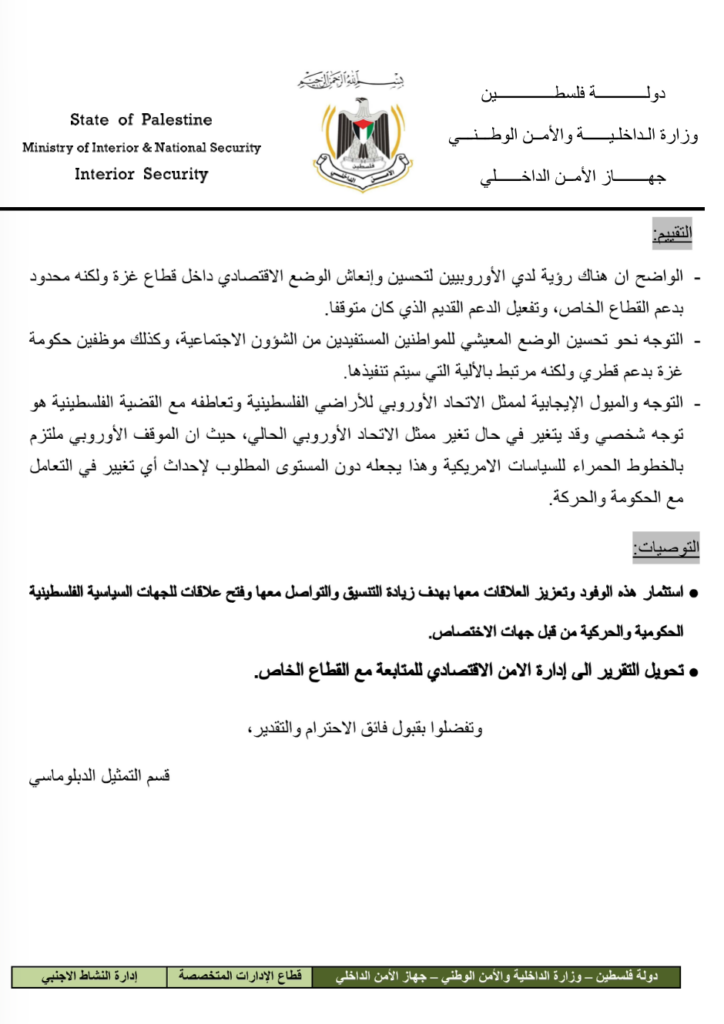
An internal Hamas document produced by their “Ministry of Interior”
In the document, dated 28 September 2021, officials from Gaza’s Hamas-run interior ministry describe Kühn von Burgsdorff as “a professional figure” who “strongly supports and sympathises with the Palestinians”.
“He is demanding [that the EU] open official channels to engage with Hamas, but the public policy of the EU dismisses this,” the document states.
At the same time, Hamas officials acknowledge that the envoy’s stance did not reflect the EU’s institutional position and could change with his departure.
“The positive approach and inclinations of the EU representative to the Palestinian territories and his sympathy with the Palestinian cause are a personal approach, and this might change when the current EU representative changes, since the European position is committed to the red lines of American policies,” the document reads.
Asked about Hamas’ assessment of his conduct, Kühn von Burgsdorff told Euractiv that he acted fully within his mandate.
“I have defended the internationally enshrined right to self-determination of the Palestinian people in full compliance with and implementation of applicable EU policy,” he said.
He added that he consistently represented Brussels’ official position. “At no point have I made public statements that contradicted the EU’s officially adopted policy towards Israel and Palestine,” he said.
Last year, Kühn von Burgsdorff contributed two op-eds to Euractiv on the Gaza conflict, including one under the headline “The EU’s moral collapse”.
‘Jerusalemite martyrs’
The Hamas report also claims that Kühn von Burgsdorff was “hated by both the Israeli occupation and the Palestinian Authority” due to his solidarity with “Jerusalemite martyrs” whose homes were demolished, and his expressions of sympathy following the death in custody of Nizar Banat, a Palestinian activist and critic of the Palestinian Authority.
The document recommends strengthening coordination and communication between the EU and “Palestinian political, governmental and [Hamas] movement parties”.
Olga Deutsch, vice-president of NGO Monitor, said the documents confirm that Kühn von Burgsdorff “actively worked to undermine official EU anti-terror vetting policies”.
“It is deeply troubling to see a senior EU diplomat engage in open, ideological political advocacy, particularly when it serves an EU-designated terror group,” Deutsch told Euractiv. “In Hamas’ own words, he even ‘demanded’ the opening of official EU channels to engage with a proscribed terror organisation – an appalling subversion of EU regulations and a blatant contradiction of the Union’s public policy.”
She added that the EU must significantly strengthen its internal controls and vetting mechanisms. “How can the EU guarantee that its grantees are not engaging in terror glorification if it cannot even vouch for its own diplomats?” she said.