
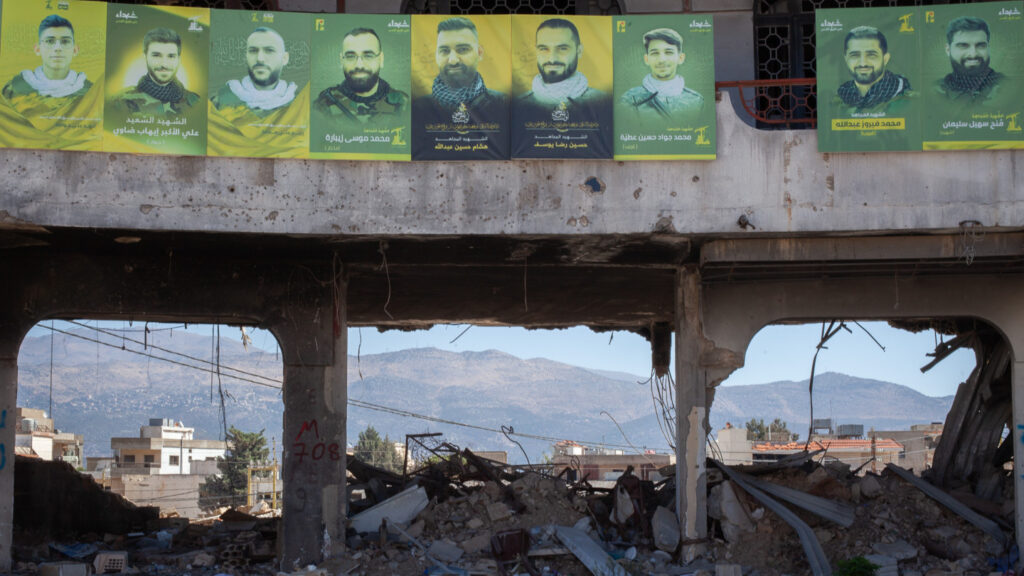
A year on from the ceasefire, displaced civilians in south Lebanon continue to live under near-daily Israeli airstrikes, drones, and military occupation
South Lebanon – Ali Hammoud looked worn out, staring blankly at the little fire and the pot of boiling vegetables that would soon be his dinner. There is no gas, water or electricity, so he is cooking outdoors. And though an Israeli airstrike had torn away one side of his house, he is glad to be back.
Displaced by war for almost two years, the Hammouds are one of the few families to brave the return to the shattered remains of Houla, a once picturesque village in southern Lebanon, just a mile from the border with Israel.
“We returned because this is our land, and this is our house … And we didn’t know how to live anywhere else,” May Hammoud, Ali’s wife, told The New Arab.
May lamented the destruction that surrounded her. “If you go up that way,” she said, pointing to the steep hill behind her home, “all the olive trees have been ripped out. And over there was a water source for people to drink. They [Israeli soldiers] removed it too. They left nothing.”
More than a year has passed since the ceasefire agreement that ended 13 months of war between Israel and Hezbollah. But for the Hammouds, the war is not over yet. Israeli soldiers still occupy five “strategic” hilltops along the Lebanese side of the border.
The sound of an Israeli MK drone keeps the couple and their children up at night and on edge throughout the day. Under surveillance and near-daily bombardment, for residents of the south, it is a ceasefire in name only.
The New Arab visited four Lebanese border villages around the first anniversary of the ceasefire. For some residents, it is still too dangerous to return. But many others have nothing to return to.
The string of about a dozen villages closest to the Israeli border is mostly abandoned and still in ruins. Some villages, such as Kfar Kila, have been practically erased from the map. Over 64,000 people, mostly residents of southern Lebanon, remain displaced in other parts of the country.
“People feel vulnerable, they never know when the drone, or even war, will return,” May said. “Once, there were helicopters flying above us the whole night. It put me in a bad mental state, but now, thank God, I’ve adapted to it.”
As May spoke, the dreaded but unmistakable thrum of an Israeli drone filled the air. The Hammouds became silent for a moment. The birds stopped singing, too.
May said the presence of journalists might have attracted the drone to the village, as the car was not from the area. “They seem to have memorised the locals,” she said.
Airstrikes rain down almost daily in the south, as Israel ramps up its attacks against what it claims are Hezbollah targets. But civilians are dying too. Israel has killed 127 civilians in Lebanon since the ceasefire took effect, according to the UN human rights office.
In the border town of Bint Jbeil, Hussein, who only gave his first name, said he witnessed the aftermath of the strike that killed most of the Charara family in September. The three children, all seated in the back of the car, had been decapitated by the blast, he said.
“The mother had to watch her children and husband killed in front of her,” Hussein said over a coffee and a cigarette in the hardware shop where he works. “I went and saw with my own eyes, her children with no heads. Too many terrible moments. Even now, you still feel there is a silence over the town.”
Recent strikes have also targeted a cement factory and a site selling heavy machinery, destroying dozens of vehicles. Lebanese officials say these are attempts to hinder reconstruction and make life in the south impossible.
The Israeli military has repeatedly stated that it is targeting Hezbollah fighters and infrastructure to prevent the Iran-backed group from rearming. But the commander of the UN’s peacekeeping mission in South Lebanon contradicted these claims in a recent statement, saying there was “no evidence” Hezbollah was rebuilding its capabilities in the south.
Analysts say Israel appears to be imposing a de facto buffer zone in southern Lebanon – a strategy it is also pursuing on its border with Syria, where Israeli forces have occupied a strip of land since the Assad regime was toppled last year.
“After 7 October, there’s been this shift in thinking, and it seems that is being reflected in Israeli government policy. Israel does not want to see potential threats on its borders. It will no longer tolerate that,” David Wood, a senior Lebanon analyst for the International Crisis Group (ICG), told The New Arab.
Both sides have failed to implement the ceasefire agreement in full: Hezbollah refuses to disarm, while Israel has still not withdrawn fully from southern Lebanon. However, Israel is responsible for the vast majority of ceasefire violations, with the UN recording more than “10,000 Israeli air and ground violations” in the year since 27 November 2024, when the truce took effect.
Hezbollah’s Secretary-General Naim Qassem said in an interview with the group’s affiliated TV station, Al-Manar, that there was a possibility of renewed conflict with Israel. Though Hezbollah has “no intention” of starting a war, he said, “we will remain a resistance group even if we have nothing left”.
In Khiam – another heavily destroyed border town – about half of the residents have returned, and a few of those with enough savings have begun rebuilding their own houses. The roads are clear, and most of the surviving houses have electricity again.
But part of the town remains cordoned off by Israel, preventing around 1,000 residents from returning. A tangle of razor wire and a soldier of the Lebanese Army mark the boundary. In accordance with the ceasefire agreement, the army has deployed 10,000 soldiers to the south and is manning some 200 checkpoints there.
The rest of Khiam remains as The New Arab found it in January, not long after Israeli forces withdrew: reduced to rubble. One wall still bore graffiti in Hebrew, left there by an Israeli soldier a year ago.
Abbas al-Sayyed, the mayor of Khiam, said reconstruction was being blocked for “political reasons”.
“The countries who usually help us are not prepared to because there are sanctions against us. American sanctions. You know that America is in control of most of the region. They can make the money come… they can make the money stop,” Sayyed said.
Amnesty International reported in August that over 10,000 civilian structures were destroyed by Israel in southern Lebanon, many of them after the ceasefire, and called for those actions to be investigated as war crimes. The World Bank has assessed that Lebanon needs around $11 billion for post-war recovery and reconstruction.
Sayyed is confident the town’s residents, about half of whom work abroad, will rebuild Khiam with their personal savings.
“We have had three wars with the Israelis. And we have rebuilt Khiam three times. So, we are used to rebuilding,” he said. “We will build. Because we are born here, we’re going to die here. No one can push us out.”
Much of the foreign aid earmarked for Lebanon’s reconstruction by countries like the US and Saudi Arabia is conditional on Hezbollah’s disarmament. Until that happens, much of southern Lebanon will remain a wasteland.
Meanwhile, Lebanon’s government – under increasing US pressure to disarm Hezbollah – is cornered between the threat of civil war at home or another escalation from Israel.
Hopes of an expanded truce were raised when, for the first time in decades, talks were held last week between Lebanese and Israeli civilian representatives in an early bid to establish economic cooperation.
“The economics won’t matter in any meaningful way until there’s certain baseline conditions met,” Wood explained. “And one of them is to have some sort of durable security agreement in place so that people can live safely on both sides of the border.”
But a lasting security agreement still seems a distant prospect, and the current stalemate could have broader consequences. All of Lebanon’s sects, including Christians, Sunnis, and Druze, are represented in southern Lebanon.
Many say they feel abandoned, or that the government in Beirut is too weak to intervene against Israel. But others grow increasingly frustrated at Hezbollah’s refusal to lay down its arms, raising fears of sectarian strife.
“It’s hard to imagine that Lebanon can fully emerge from these consecutive crises of the past six years, starting with the economic crisis and through to the war, until there’s a permanent cessation of hostilities,” Wood said. “Lebanon’s fate is tied up with the fate of the south.”
Back in Bint Jbeil, Hussein, like most of his neighbours, expressed a sense of hopelessness. He sees the situation in the south as beyond his control, and says it is up to the politicians to decide when it will end.
“It’s all ink on paper, it’s all talk.”